In today's competitive job market, the pressure to fill roles quickly is immense. However, this speed can expose your hiring funnel to significant risks from fraudulent applicants. Misrepresentation on resumes has become alarmingly common; a recent Checkster report revealed that 78% of candidates admit to misleading potential employers.
These deceptions range from minor exaggerations to completely fabricated identities, costing companies thousands in wasted resources and bad hires. Understanding the subtle but critical fake candidate signs is the first step in protecting your enterprise.
This guide will walk you through seven key indicators of a fraudulent application, moving beyond the obvious to what truly matters.
What Do Inconsistent and Unprofessional Contact Details Reveal About Candidates?
Inconsistent contact information is one of the most immediate fake candidate signs. It often indicates a lack of attention to detail or, more concerningly, a deliberate attempt to create a superficial or untraceable identity for fraudulent purposes.
Name Mismatches: The name on the resume differs from the name used in the email address or on a LinkedIn profile. This could signal a hastily created persona.
Geographic Disconnects: A phone number with a New York area code does not match a listed address and work history exclusively in California. This requires immediate clarification.
Disposable Email Addresses: The use of non-professional or randomly generated email addresses (e.g., xyz123abc@domain.com) can suggest the account was created just for this application.
Shared Contact Information: Multiple applications received over time from different "candidates" using the same phone number or email is a major indicator of an organized fraud ring.
Why Are Vague Job Descriptions a Major Red Flag for Recruiters?
Vague job descriptions are a clear resume red flag because genuine candidates with real experience can articulate their accomplishments specifically. Fraudsters rely on generic language to fill space without providing details they cannot later substantiate.
Lack of Specific Metrics
A qualified professional will quantify their achievements. A fraudulent resume will state "Managed social media" instead of "Grew social media engagement by 45% over two quarters."
Overuse of Boilerplate Text
Fraudulent resumes often lift generic duty descriptions directly from job postings online. The language feels impersonal and lacks any unique detail about their specific contributions.
Focus on Responsibilities, Not Results
The content describes what the person was supposed to do, not what they actually achieved. This is a common tactic to appear qualified without having any real experience.
Absence of Tools and Software
A real professional would mention the specific software, tools, or platforms they used (e.g., Salesforce, JIRA, Adobe Creative Suite). Omitting these specifics is a telling sign.
How To Identify an Unverifiable Work and Education History in a Resume?
An unverifiable history is a foundational element of a fraudulent application. Bad actors create fictitious companies and list degrees from non-existent institutions, knowing that many recruiters lack the time for thorough verification. This is a critical area for fraudulent resume detection.
Ghost Companies: The listed previous employers have no website, no digital footprint, and no official registration records. A quick search reveals they do not exist.
Diploma Mills: The candidate claims a degree from a university that is not accredited or is a known "diploma mill" that sells certificates without legitimate academic coursework.
Inconsistent Timelines: Employment dates overlap in illogical ways, or there are significant, unexplained gaps that the candidate is evasive about.
Fake References: References provided use the same phone number as the candidate or are equally untraceable online, suggesting they are part of the deception.
In today's competitive job market, the pressure to fill roles quickly is immense. However, this speed can expose your hiring funnel to significant risks from fraudulent applicants. Misrepresentation on resumes has become alarmingly common; a recent Checkster report revealed that 78% of candidates admit to misleading potential employers.
These deceptions range from minor exaggerations to completely fabricated identities, costing companies thousands in wasted resources and bad hires. Understanding the subtle but critical fake candidate signs is the first step in protecting your enterprise.
This guide will walk you through seven key indicators of a fraudulent application, moving beyond the obvious to what truly matters.
What Do Inconsistent and Unprofessional Contact Details Reveal About Candidates?
Inconsistent contact information is one of the most immediate fake candidate signs. It often indicates a lack of attention to detail or, more concerningly, a deliberate attempt to create a superficial or untraceable identity for fraudulent purposes.
Name Mismatches: The name on the resume differs from the name used in the email address or on a LinkedIn profile. This could signal a hastily created persona.
Geographic Disconnects: A phone number with a New York area code does not match a listed address and work history exclusively in California. This requires immediate clarification.
Disposable Email Addresses: The use of non-professional or randomly generated email addresses (e.g., xyz123abc@domain.com) can suggest the account was created just for this application.
Shared Contact Information: Multiple applications received over time from different "candidates" using the same phone number or email is a major indicator of an organized fraud ring.
Why Are Vague Job Descriptions a Major Red Flag for Recruiters?
Vague job descriptions are a clear resume red flag because genuine candidates with real experience can articulate their accomplishments specifically. Fraudsters rely on generic language to fill space without providing details they cannot later substantiate.
Lack of Specific Metrics
A qualified professional will quantify their achievements. A fraudulent resume will state "Managed social media" instead of "Grew social media engagement by 45% over two quarters."
Overuse of Boilerplate Text
Fraudulent resumes often lift generic duty descriptions directly from job postings online. The language feels impersonal and lacks any unique detail about their specific contributions.
Focus on Responsibilities, Not Results
The content describes what the person was supposed to do, not what they actually achieved. This is a common tactic to appear qualified without having any real experience.
Absence of Tools and Software
A real professional would mention the specific software, tools, or platforms they used (e.g., Salesforce, JIRA, Adobe Creative Suite). Omitting these specifics is a telling sign.
How To Identify an Unverifiable Work and Education History in a Resume?
An unverifiable history is a foundational element of a fraudulent application. Bad actors create fictitious companies and list degrees from non-existent institutions, knowing that many recruiters lack the time for thorough verification. This is a critical area for fraudulent resume detection.
Ghost Companies: The listed previous employers have no website, no digital footprint, and no official registration records. A quick search reveals they do not exist.
Diploma Mills: The candidate claims a degree from a university that is not accredited or is a known "diploma mill" that sells certificates without legitimate academic coursework.
Inconsistent Timelines: Employment dates overlap in illogical ways, or there are significant, unexplained gaps that the candidate is evasive about.
Fake References: References provided use the same phone number as the candidate or are equally untraceable online, suggesting they are part of the deception.


What Does a Candidate's Digital Footprint (or Lack Thereof) Tell You?
In the modern professional world, a digital footprint is expected. The absence or suspicious nature of an online presence is one of the most revealing fake candidate signs, suggesting the persona may not be real or was recently fabricated.
No LinkedIn Profile: While not everyone uses LinkedIn, it is highly unusual for a professional in fields like tech, marketing, or finance to have no profile at all.
A "Ghost" LinkedIn Profile: The candidate has a profile, but it was created recently. It has very few connections (under 50), no recommendations, no activity, and a stock profile picture.
Inconsistent Online Information: The job titles, companies, or timelines listed on a social media profile conflict with the information provided on the resume. This shows a clear lack of consistency.
No Other Professional Presence: There is no trace of the candidate on other professional networks, industry forums, or even a simple Google search. A real person usually leaves some form of digital trail.
Are the Candidate's Skills and Experience Claims Internally Consistent?
Beyond verifying external facts, you must analyze the resume for internal logic. Many fake candidate signs emerge when the story does not add up. A fraudster may list impressive skills but fail to connect them to their experience.
Advanced Skills, Junior Experience: The resume claims expert-level proficiency in a complex skill (e.g., advanced machine learning) but only lists entry-level roles or short-term projects.
Mismatched Job Titles and Responsibilities: A candidate lists a title like "Project Manager" but then describes tasks that are purely administrative or data entry.
Generic "Soft Skills" Lists: The skills section is padded with a long list of buzzwords like "team player," "good communicator," and "problem solver" without any examples in the job history.
Experience vs. Education Timeline: The candidate claims to have five years of work experience but their graduation date from college was only two years ago.
Why Is Resistance to Standard Screening a Warning Sign for Recruiters?
A candidate’s behavior during the hiring process is as revealing as their resume. One of the clearest behavioral fake candidate signs is an unwillingness to comply with standard, transparent screening procedures, often because it would expose them.
Refusal of Video Interviews
This is the most significant red flag for a proxy interview, where a different person takes the interview. They may insist on a phone-only call, citing a broken camera or poor internet.
Hesitation with Identity Verification
The candidate stalls or refuses to provide documentation for standard candidate identity verification as part of a background check, which is a key part of recruitment fraud prevention.
Unusual Communication Patterns
They communicate only through email, refuse to provide a direct phone number, or respond at odd hours, which could indicate they are in a completely different time zone.
Pressure for Quick Decisions
The candidate attempts to rush the process and secure an offer before you have time to conduct proper due diligence, hoping you will skip crucial verification steps.
What Do Evasive Answers and Poor Communication During the Hiring Process Indicate?
Even if a resume seems perfect, the communication and interview stage can reveal the truth. A candidate who cannot speak coherently about their listed experience is a major concern. Learning how to spot a fake candidate often comes down to listening carefully.
Vague and Scripted Answers: When asked for details about a project, they give high-level, generic answers that sound rehearsed and lack depth.
Inability to Elaborate: They cannot explain the "how" or "why" behind their achievements. For example, they can't detail the steps they took to "increase efficiency by 30%."
Poor Language Skills: The candidate's spoken fluency is noticeably different from the polished, professional language used on their resume, another sign it was written by someone else.
Deflecting Technical Questions: When faced with technical questions, they redirect the conversation or provide textbook definitions instead of practical application examples.
Why Hello Recruiter Is Your Reliable Partner for Fake Candidate Detection?
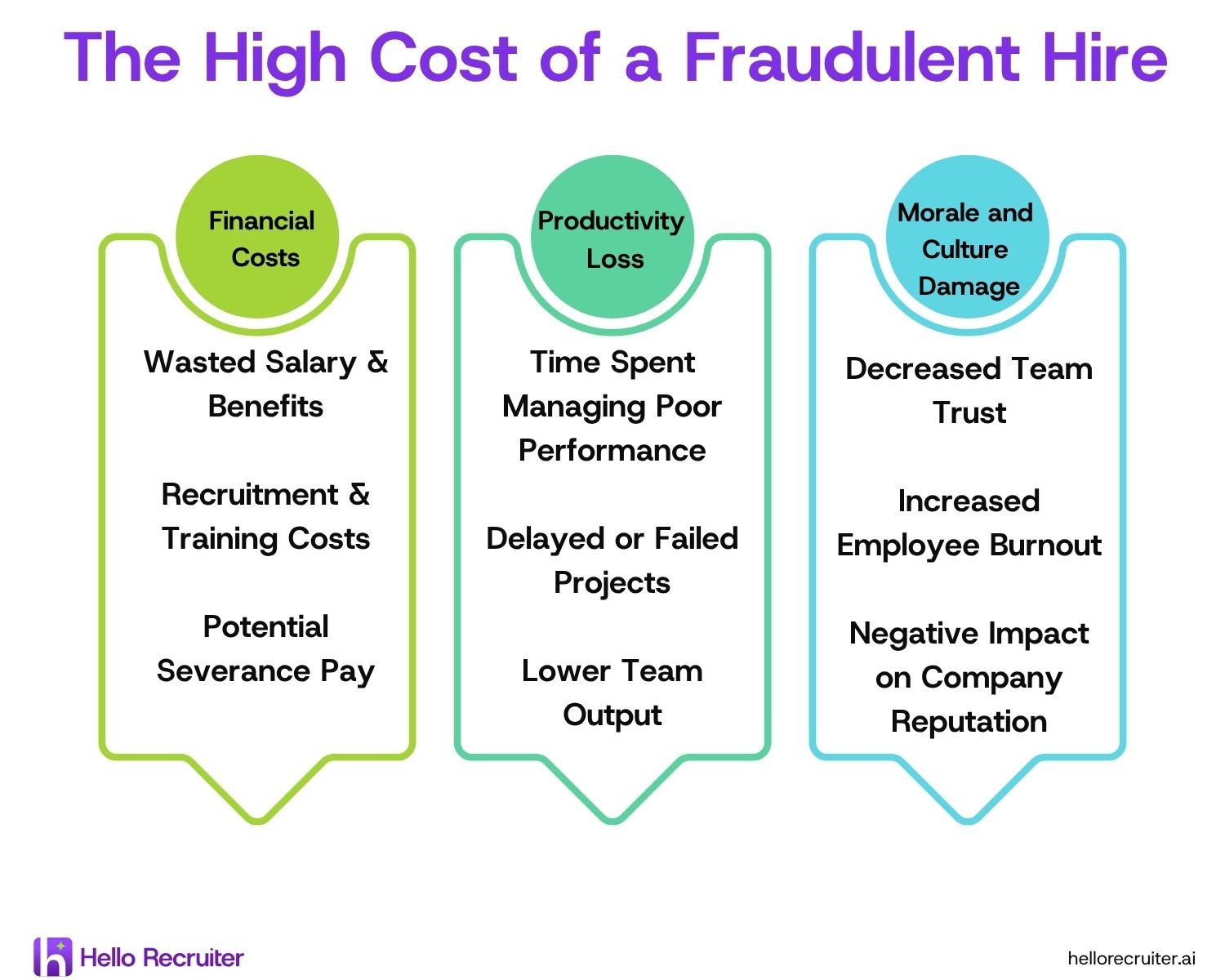
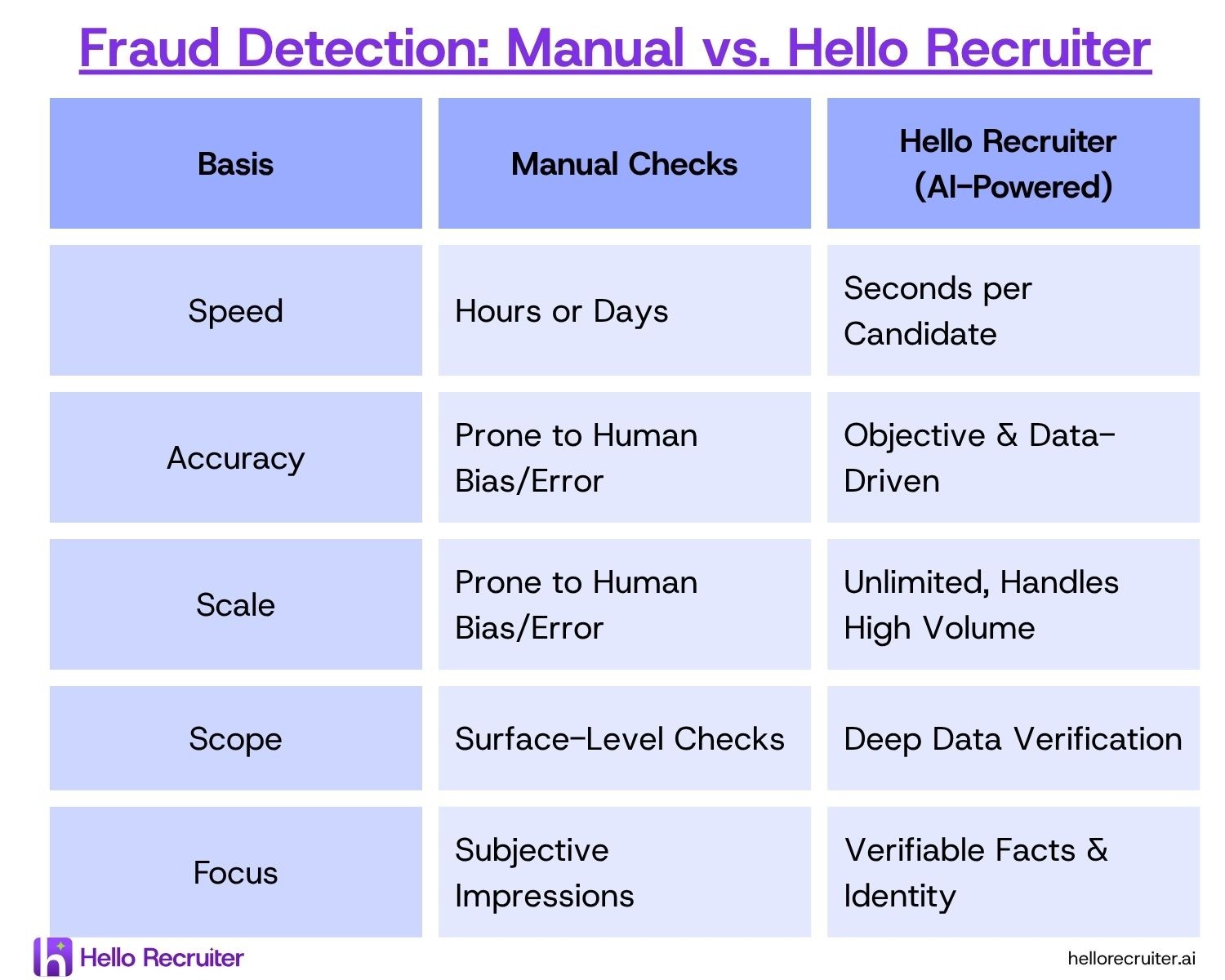
Manually checking for these seven fake candidate signs is time-consuming, prone to human error, and simply not scalable for modern recruiting teams. According to a Society for Human Resource Management (SHRM) report, a bad hire can cost an organization up to five times the employee's annual salary. Relying on manual checks alone is no longer a viable defense.
This is where AI in hiring becomes a necessity. Hello Recruiter moves beyond simple keyword matching to provide robust, automated protection for your hiring funnel. Our platform is designed for advanced fraudulent resume detection and candidate identity verification.
We analyze hundreds of data points in seconds, flagging inconsistencies and verifying identities with a level of accuracy that is impossible to achieve manually. We empower your team to focus on engaging with genuine, qualified talent, not policing applications for fraud.
Ready to secure your hiring funnel? Schedule a personalized demo today and take the first step toward a faster, safer, and more secure hiring process.
Frequently Asked Questions (FAQs)
What is the most common lie on a resume?
The most common misrepresentations on resumes involve exaggerating job titles and responsibilities. Candidates often inflate their roles or claim credit for team achievements to appear more qualified than they actually are, making these key resume red flags to watch for.
How do you verify if a candidate is real?
You can verify a candidate by cross-referencing their resume with a professional online presence like LinkedIn, conducting background checks, and verifying their employment and education history directly with the institutions. Using a tool like Hello Recruiter automates this candidate identity verification.
What is a proxy interview?
A proxy interview is a form of recruitment fraud where an imposter with more expertise poses as the candidate during a phone or video interview. A primary red flag is a candidate’s strong resistance to turning on their camera for a video call.
Can a company take legal action for a fake resume?
Yes, if a company hires an employee based on fraudulent information and subsequently suffers damages, it may have grounds for legal action. This emphasizes the importance of robust, upfront recruitment fraud prevention to avoid such costly situations.
How can AI help prevent hiring fraud?
AI systems can analyze thousands of applications to detect subtle patterns of fraud that humans would miss. AI platforms can verify identities, cross-reference data points for consistency, and flag suspicious profiles in real-time, making the hiring process far more secure.
Recruitment Fraud, Hiring Security, Fake Candidates, Resume Fraud, AI Recruiting, Bad Actor Detection, Candidate Screening, Hiring Funnel, Talent Acquisition, HR Technology