
Today when a single job post goes live- it gets hundreds of applications within minutes, and the number keeps increasing with every passing minute. Employ's 2026 Hiring Benchmarks Report built from data across more than 6,600 companies, found that organizations are seeing roughly 50 more applicants per role than they did the year before.
Manually reviewing such a large volume of resumes is nearly impossible. That’s why hiring teams have adopted screening technologies to help them identify strong candidates and avoid missing qualified applicants simply because they could not review every resume in time.
In this guide we have researched and compared top 10 AI screening software platforms for 2026, what each one is genuinely good at, what it costs, and where it falls short. We are one of the 10 and we say so upfront.
First lets quickly understand what AI screening software is and then dive into the complete list.
What Is AI Screening Software?
AI screening software is a recruiting tool that uses artificial intelligence to automatically read, score, and rank job applications. It uses machine learning to evaluate job applicants before a recruiter even picks up the phone.
It can help you with resume parsing and ranking, running a live or recorded interview, a live skill test then hand you a shortlist of applicant’s basis your criteria.
The best AI screening software keeps the final hiring decision with a human instead of making it independently. It should support recruiters by screening applications and creating a shortlist, so they spend less time on candidates who are not a strong fit for the role.
According to SHRM's 2025 Talent Trends report, which surveyed 2,040 HR professionals, screening resumes is already the second most common way organizations use AI in HR, right behind writing job descriptions.
The Three Types of AI Screening (and Which One You Need)
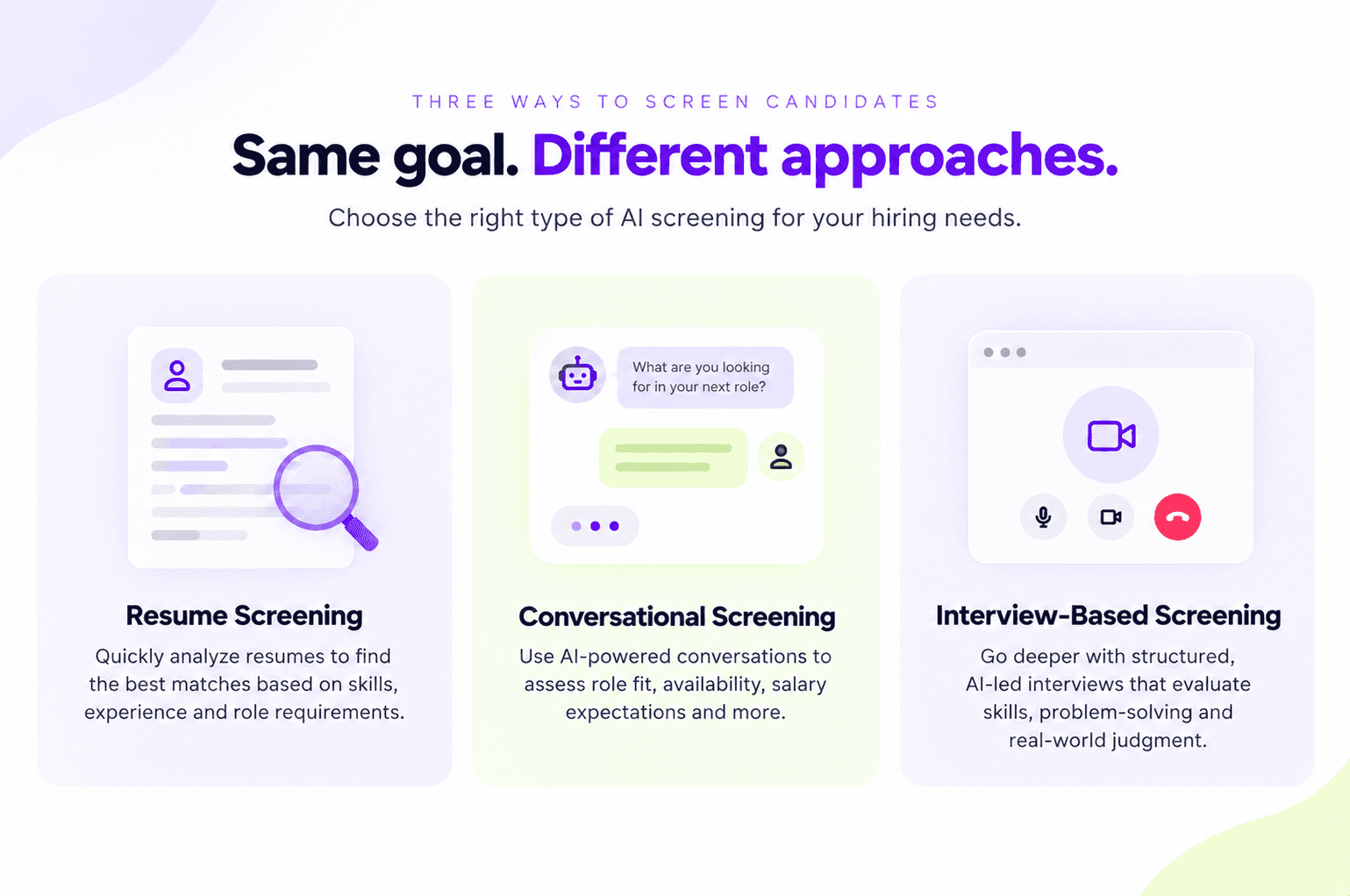
Most AI screening tools fit into three main categories. Understanding which type you need before comparing vendors helps you avoid wasting time on demos for solutions that are not the right fit.
Resume and CV screening: Resume and CV screening is the most established type of AI candidate screening. It reviews incoming resumes, compares them with the job requirements, and ranks applicants by fit. Modern tools go beyond keyword matching by recognizing context, so a resume that mentions “managed a $2M budget” can still be credited for profit and loss experience even if it does not use that exact term.
Conversational screening: Conversational screening replaces the traditional phone screen. A chat or voice agent asks qualifying questions through SMS, web chat, or phone, evaluates the responses, and sends only qualified candidates to a recruiter. It is especially useful for high-volume roles in retail, hospitality, and call centers, where teams may receive hundreds of applications each week.
Interview-based screening: This uses a structured async or live interview, often over video, audio, or text, as the actual first-round filter. Instead of a recruiter running 30 identical intro calls, the AI runs the structured conversation and gives you a scored transcript.
Plenty of tools now blend two of these. That's part of why "which one is best" is the wrong question. The right question is which one matches your hiring problems.
The Top 10 AI Screening Software Platforms in 2026
Tool | Best For | Standout Feature | Starting Price |
|---|---|---|---|
Multiple interview styles. SMBs and staffing agencies seeking one platform instead of several tools | Resume ranking, HR interviews, technical screening, and phone screening in a single system. | Free plan; paid plans start at $29 | |
HeyMilo | A two-way voice or video interview as the first round | Live, adaptive follow-up questions instead of a static form | Custom pricing |
HireVue | Enterprise teams wanting structured video interviews plus validated assessments | Large existing interview dataset for benchmarking | Enterprise, contracts historically $30K to $100K+ a year |
Humanly | High-volume hourly and frontline hiring | Screens and schedules over SMS, chat, email, and voice | Custom pricing |
BrightHire | Teams that already run live interviews and want them structured, now backed by Zoom | BrightHire Screen adds async first-round screening on top of interview intelligence | Custom, three quote-based tiers |
Metaview | Teams that want interview intelligence plus growing coverage of sourcing and scheduling | Native, Greenhouse and Lever integration | Free notetaker up to 25 calls/month, paid tiers beyond that |
TestGorilla | A ready-made library of validated skills tests | 350+ tests across cognitive, technical, language, and personality skills | Free tier, Core around $142/month |
CodeSignal | Engineering teams that need a coding assessment before the technical interview | Keystroke replay shows how a candidate actually worked through a problem | From around $99/month, Pro tier custom |
Eightfold AI | Large enterprises connecting external hiring to internal mobility | Talent rediscovery from your own ATS archive | Enterprise, typically six figures a year |
Phenom | Enterprises treating screening as one piece of a full talent experience platform | AI career site personalization tied to screening and scheduling | Enterprise, custom |


Hello Recruiter:
Hello Recruiter is built to take care of all the time-consuming repetitive tasks of recruiters so that they can focus on actual work that matters. Right from Screening to interviewing to creating a shortlist with evaluation- Hello Recruiter does it all while leaving the judgement part to actual human. Hello Recruiter’ AI agents do it all- SCOUT ranks resumes as soon as they come in, ARIA takes care of the screening live interviews and phone screening call, MAX handles the technical rounds with live coding, vibe coding and take-home assessments with follow-ups and WHIX handles the whiteboarding part.
Along with all the work these agents do, we also have other features like fraud and risk detection, two-way interviews, knowledge base and much more.
A five-person recruiting team can handle multiple open roles/client request at once right from resume screening to technical rounds and interview without needing multiple tools or separate user plans.
Every candidate is told upfront they're talking to AI, and Hello Recruiter is built to support a recruiter's decision, not make it for them.
Best for: SMBs and staffing agencies that want resume screening, HR interviews, technical screening, and phone screening with ranked shortlist and reasoning behind each score all in one platform.
Pricing: Priced per organization rather than per seat or per interview. Free plan available, paid plans start at $29.
HeyMilo:
HeyMilo is a recruiting and interviewing platform that automates early-stage candidate screening through conversational voice, video, and text agents. It runs real two-way voice and video interviews that ask follow-up questions based on what the candidate just said, instead of working off a fixed script.
It's built specifically for staffing agencies and other high-volume hiring teams.
See Hello Recruiter vs. HeyMilo for a full side-by-side.
Best for: Teams that want a genuine conversational first-round interview rather than a static form.
Pricing: Custom, contact the vendor.
HireVue:
HireVue has been in enterprise video interviewing longer than almost anyone else in this list, and that shows up in how many ATS platforms it plugs into and how deep its assessment library runs.
If you're running structured interviews at real scale and want game-based or skills assessments layered in, this is the mature option.
Full breakdown at Hello Recruiter vs. HireVue.
Best for: Large teams that want structured video interviews plus a validated assessment library.
Pricing: Historical estimates put enterprise contracts between $30,000 and $100,000+ a year, though some products are priced per interview instead.
Humanly:
Humanly is built for the specific problem of hiring hundreds of hourly workers at once.
Its AI recruiter and talent CRM screen, schedule, and interview candidates across SMS, chat, email, and voice, and it's aimed at retail, hospitality, and contact centre hiring where speed to first contact matters more than assessment depth.
Compare it directly at Hello Recruiter vs. Humanly.
Best for: High-volume hourly and frontline hiring.
Pricing: Custom.
BrightHire:
BrightHire records and transcribes the live interviews you're already running, then scores them against structured competencies so panels stop relying on memory and gut feeling.
Zoom acquired BrightHire in late 2025, and it now runs as a standalone brand inside Zoom's infrastructure. It's also added BrightHire Screen, an async voice interviewer that can run first-round screening without a human on the call.
See Hello Recruiter vs. BrightHire.
Best for: Teams that already run plenty of live interviews and want them consistent, especially if you're already a Zoom shop.
Pricing: Custom, three quote-based tiers, no free tier.
Metaview:
Metaview started as an interview notetaker and has grown into what it now calls an Agentic Recruiting Platform, covering sourcing and scheduling alongside interview intelligence.
The notetaker itself stays free for up to 25 calls a month, and it has Greenhouse and Lever integrations, writing structured notes straight into scorecard fields.
Full comparison at Hello Recruiter vs. Metaview.
Best for: Teams that want interview intelligence now, with room to add sourcing and scheduling later.
Pricing: Free notetaker up to 25 calls a month, paid tiers scale once you add sourcing.
TestGorilla:
When the problem isn't screening depth but the number of different roles you're hiring for, TestGorilla's library of 350+ pre-built tests across cognitive, technical, language, and personality skills mean you're not building an assessment from scratch every time.
Side-by-side candidate comparison reports make panel decisions easier too.
Compare it at Hello Recruiter vs. TestGorilla.
Best for: Teams testing many different role types who don't want to build each assessment themselves.
Pricing: Free tier available, Core plan around $142 a month billed annually, Plus tier custom.
CodeSignal:
CodeSignal is built specifically for evaluating engineers before they reach a live technical interview.
Its pre-screen product handles async coding assessments with keystroke replay, so you can watch how a candidate worked through a problem instead of just seeing whether the final answer was right, and its Interview product covers live collaborative coding sessions.
Full breakdown at Hello Recruiter vs. CodeSignal.
Best for: Engineering teams hiring at real volume who need a consistent bar before the human technical round.
Pricing: Starts around $99 a month on entry tiers, Pro tier custom quoted.
Eightfold AI:
Eightfold is the right tool when the question is bigger than "who should I hire for this one role."
Its skills-based matching runs against a very large career-profile dataset, and its strongest use case is resurfacing qualified people already sitting in your old ATS archive instead of starting every search from zero.
Compare it at Hello Recruiter vs. Eightfold.
Best for: Large enterprises connecting external hiring to internal mobility and long-term workforce planning.
Pricing: Enterprise, typically starting in six figures annually
Phenom:
Phenom treats screening as one piece of a much larger candidate experience. Its AI career site personalizes content for every visitor, its Phenom Bot handles pre-screening conversations and scheduling, and the whole thing connects into a CRM built for nurturing candidates before a role even opens.
It plugs into ATS platforms like iCIMS, Workday, and SAP SuccessFactors.
See Hello Recruiter vs. Phenom.
Best for: Enterprises that want screening built into a full talent experience platform, not standing alone.
Pricing: Enterprise, custom.
How to Choose AI Screening Software
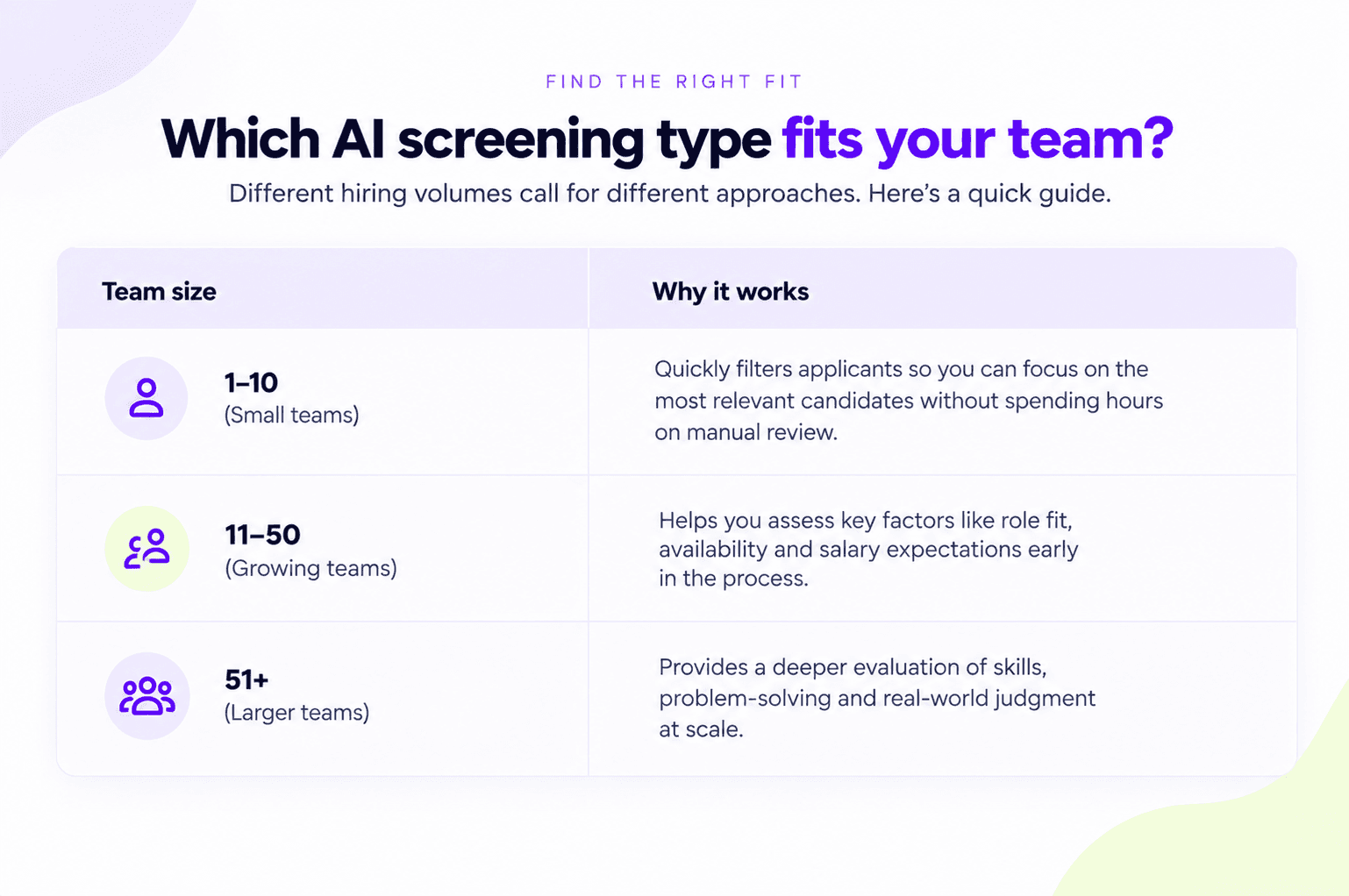
Match the tool to your problem: Too many resumes mean resume screening. Too many phone screens mean conversational or interview-based screening. Only buy this when it fits you use case.
Check what it costs to actually run, not just the sticker price: Several tools on this list look affordable until credits, seats, or per-interview fees are added up at your real volume. So do in-depth research before you commit.
Ask how it scores candidates and get a real answer: A tool that can't explain its own scoring isn't one you can defend later to a candidate or to a regulator.
Confirm it writes results back to your ATS: A screening tool that creates a new task instead of feeding your existing pipeline costs you more time than it saves.
Ask whether candidates are told they're talking to AI: This affects candidate trust and in a growing number of states your legal exposure. Get a straight answer before you sign anything.
Key Takeaways
AI screening software falls into three types: resume screening, conversational screening, and interview-based screening. Match the type to your actual problem, not the flashiest demo.
SMBs and staffing agencies should weight setup time and pricing transparency as heavily as feature depth. A platform with more features isn't automatically the right fit for a small team.
Good AI screening software augments a recruiter's judgment. It clears the applicants who clearly don't fit so a person can spend time on the ones who might, not the other way around.
Candidate disclosure and human oversight aren't just compliance boxes to check. They're part of why candidates trust the process enough to stay in it.
FAQ
What is AI screening software?
AI screening software is a recruiting tool that uses artificial intelligence to automatically read, score, and rank job applications. It uses machine learning to evaluate job applicants before a recruiter even picks up the phone.
How accurate is AI candidate screening?
Accuracy depends on how the tool scores candidates and whether that scoring is based on structured, role-relevant criteria rather than simple keyword matching. Tools that explain their scoring and let you audit a decision tend to do better than ones that hand you a black-box number.
Does AI screening software replace recruiters?
No. AI screening tools handle the repetitive early filtering, resume review, initial qualifying questions, so a recruiter's time goes toward the candidates worth a real conversation. The hiring decision still sits with a person.
Will candidates know they're being screened by AI?
They should. Look for vendors who disclose to candidates upfront that they're interacting with AI. Beyond building trust, several states are moving toward requiring this disclosure directly.
Can AI screening software reduce bias in hiring?
It can help when scoring doesn't factor in protected attributes and the criteria are applied consistently across every candidate. It can also introduce new problems if it's trained on skewed historical hiring data without checks. Ask any vendor how their scoring works and what it excludes, not just whether they call it fair.
What's the difference between AI resume screening and AI interview screening?
AI resume screening evaluates a written application against a job's requirements and ranks candidates by fit. AI interview screening replaces the early phone or video screen with a structured AI-run conversation, scored the same way for every candidate.
How much does AI screening software cost?
It ranges from free tiers and plans starting under $50 a month for smaller platforms up to six-figure annual enterprise contracts. Cost usually scales with candidate volume, seats, or how many modules of the platform you use, so confirm real usage-based pricing before comparing sticker prices.
Which AI screening software is best for small businesses or staffing agencies?
Look for a platform priced by organization rather than by seat or interview, with resume screening, interviews, and technical assessment built into one system instead of three separate subscriptions.
See how Hello Recruiter screens your next role in under 5 minutes -
AI Screening Software, AI Interviews, Recruiting Software, Small Business Hiring, Staffing Agencies, Candidate Screening Tools

Marketing Manager, Hello Recruiter
Neha is the Marketing Manager at hellorecruiter.ai, an AI hiring platform built for businesses and staffing agencies. With a background in marketing and content strategy in recruitment niche, Neha focuses on helping hiring teams understand where AI genuinely fits into recruiting. Her work spans the full arc of hiring, from how roles get defined to how the right people get chosen, and everything that happens in between.