
A structured interview is a hiring method in which every candidate for a role is asked the same questions, in the same order, and scored against the same predefined rubric. Because it removes interviewer improvisation or bias, research consistently finds it far more predictive of job performance than a free-flowing conversation.
Two candidates interview for the same role. One gets forty minutes of easy conversation about a shared alma mater. The other gets grilled on edge cases for an hour. Both get a thumbs up or a thumbs down, and nobody can explain, in writing, why.
That is not an evaluation. That is a vibe check with a calendar invite.
A structured interview fixes this by making the interview itself a controlled instrument: same questions, same order, same scoring criteria for every candidate. This guide covers what a structured interview is, how it differs from an unstructured one, example questions you can lift today, and why AI is the first tool that makes structure actually hold at scale.
What is a structured interview?
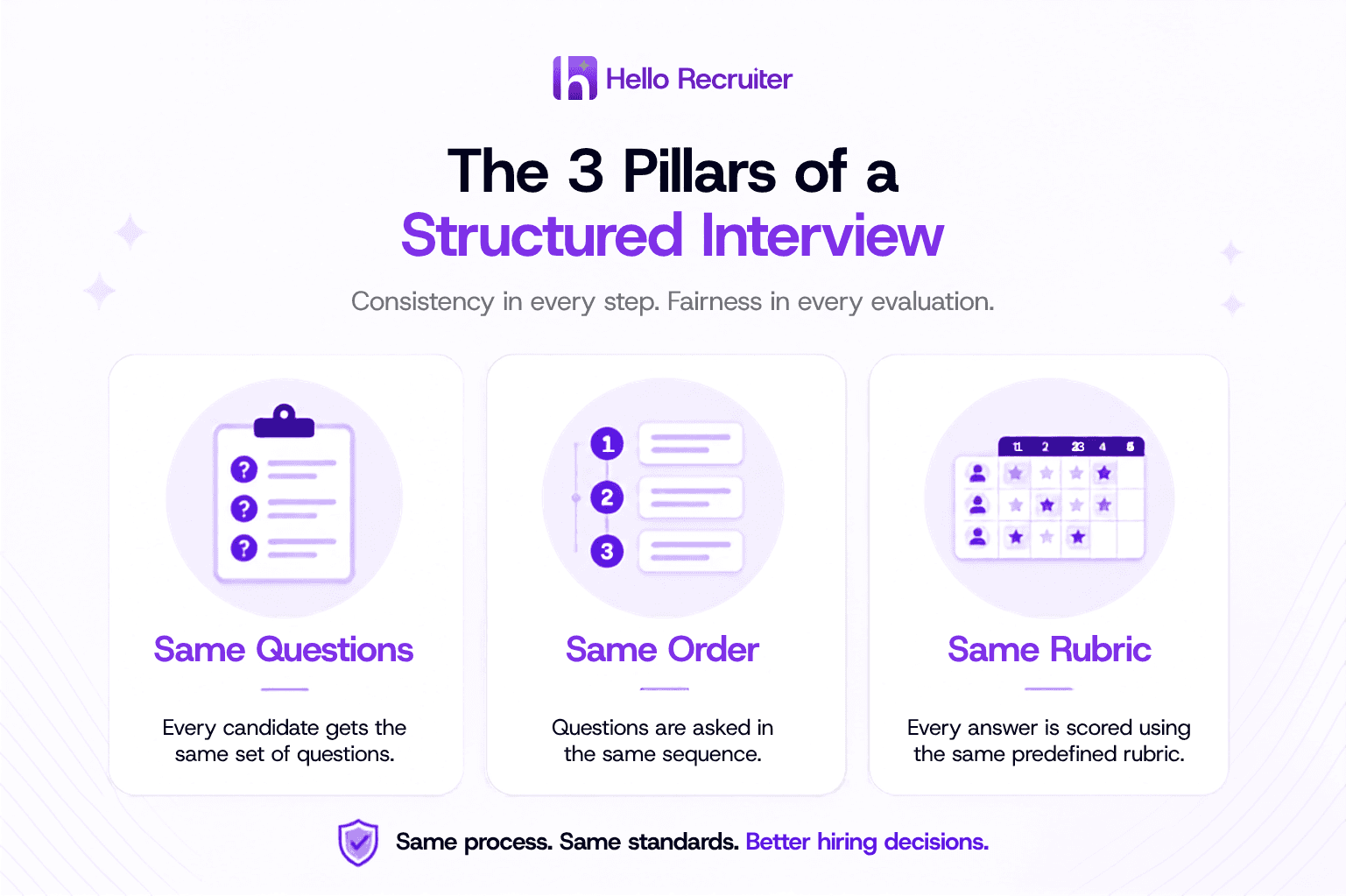
A structured interview standardizes three things across every candidate for a role:
The questions. Written in advance, derived from a job analysis, identical for everyone.
The order. Questions are asked in a fixed sequence so no candidate gets an easier or harder path.
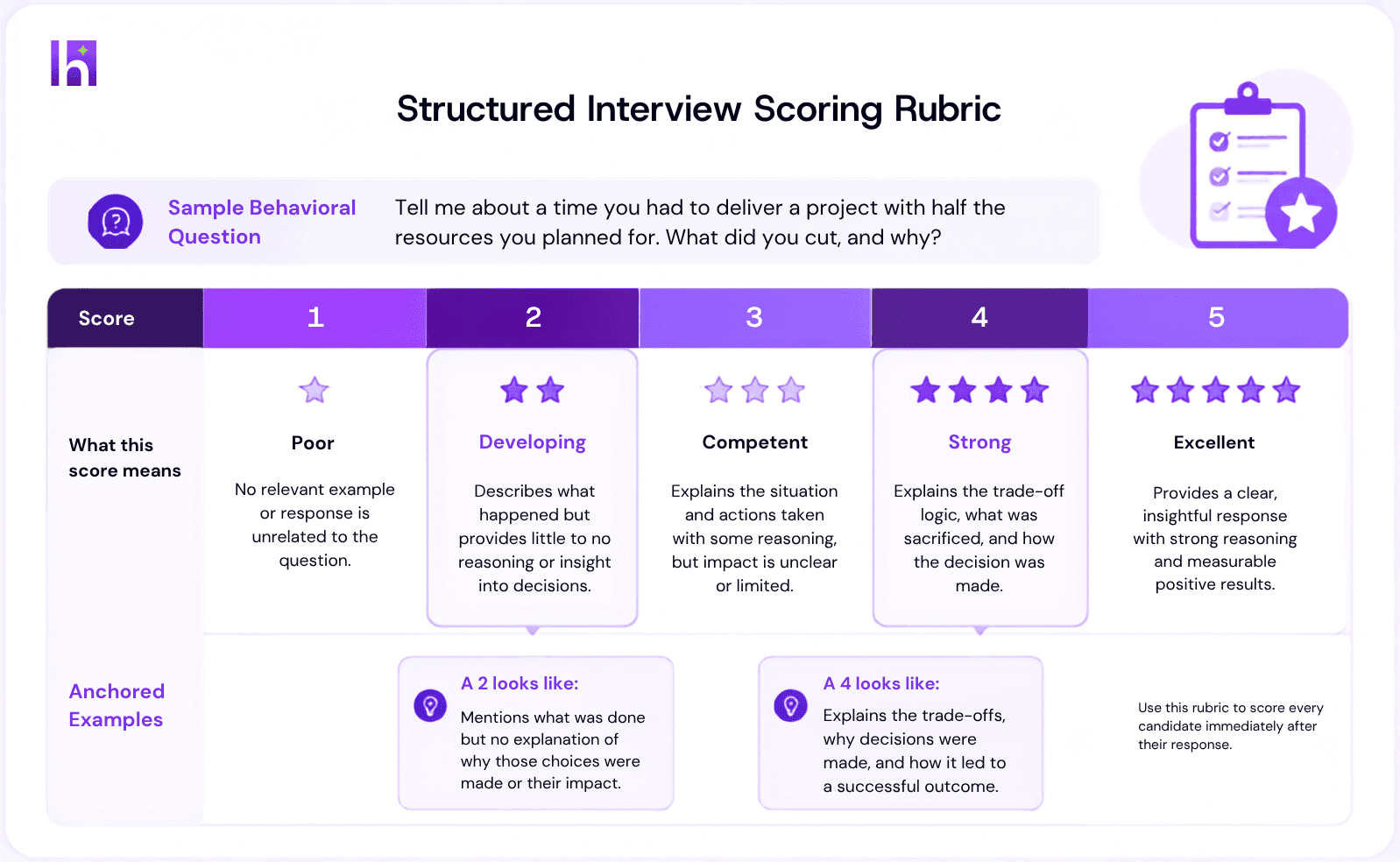
The scoring. Each answer is rated on a predefined rubric with anchored scores (for example, what a 2 versus a 4 looks like), decided before interviews begin.
If any of the three is missing, it is not a structured interview. A standardized opening followed by improvised follow-ups is the most common imposter. The rigor lives in the consistency, not in how formal the room feels.
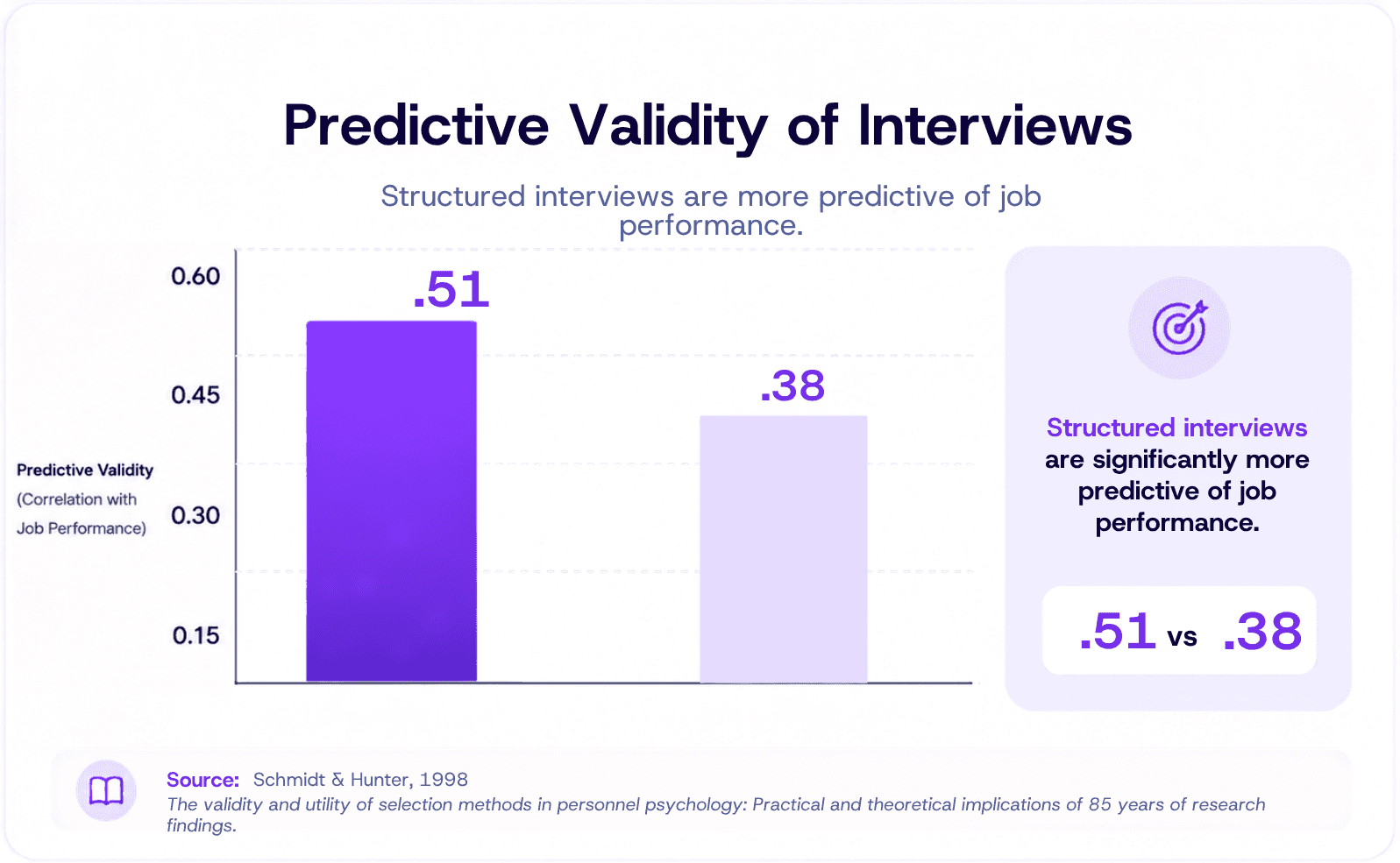
The evidence behind this is unusually strong for HR. Schmidt and Hunter's 1998 meta-analysis, the most cited study in selection research, put the predictive validity of structured interviews at .51 versus .38 for unstructured ones. Sackett et al.'s 2023 update ranked structured interviews as the single highest-validity selection method, ahead of cognitive tests and work samples, while also showing lower adverse impact on candidate groups. Google's internal re:Work research reached the same conclusion and led Google to adopt structured interviewing company-wide.
TL;DR: Same questions, same order, same rubric. Three decades of research says this is the most predictive interview format available.
Structured vs unstructured interviews: what actually changes
An unstructured interview is a conversation. The interviewer improvises questions, follows tangents, and forms an overall impression. It feels natural, which is exactly the problem: impressions form in minutes and are shaped by similarity, confidence, and rapport rather than job-related evidence.
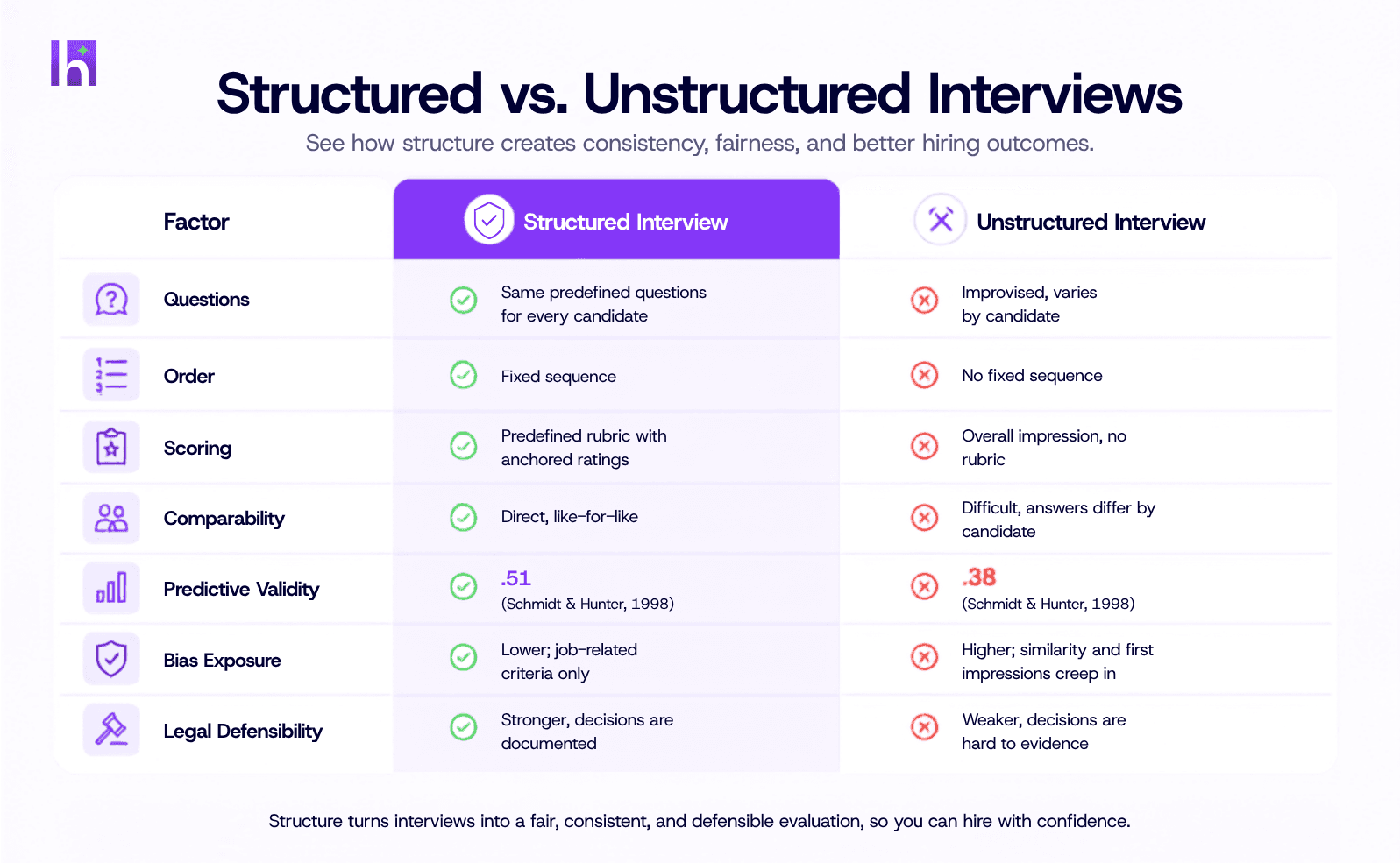
Semi-structured interviews sit in between: a fixed core plus flexible follow-ups. They preserve some comparability but give up much of the validity gain, because the improvised part is where bias re-enters. For a breakdown of all the formats, you can read on all the different interview styles.
TL;DR: Structure is not about formality. It is about producing comparable, defensible evidence for every candidate.


Structured interview example questions (with scoring)
Structured interview questions typically fall into three types, all tied to the job analysis:
Behavioral (past evidence)
“Tell me about a time you had to deliver a project with half the resources you planned for. What did you cut, and why?”
“Describe a disagreement with a colleague about the right technical or process approach. How was it resolved?”
Situational (hypothetical judgment)
“A key client threatens to leave over a mistake your team made. You have one call to fix it. Walk me through it.”
“You inherit a hiring pipeline with 200 unreviewed applicants and a role that closes in two weeks. What do you do first?”
Job-specific (skills and knowledge)
“How would you structure a sourcing strategy for a hard-to-fill insurance sales role?”
“What metrics would you track to know this role is succeeding in the first 90 days?”
Every question needs a scoring anchor written before interviews start. Example for the resource-cut question on a 1 to 5 scale: a 2 describes what happened with no reasoning; a 4 explains the trade-off logic, names what was sacrificed, and ties the decision to the outcome. Interviewers score each answer immediately after it is given, not at the end from memory.
TL;DR: Mix behavioral, situational, and job-specific questions, and never write a question without also writing what a good and a weak answer look like.
How AI makes structured interviews actually consistent
Here is the uncomfortable truth the research rarely spells out: adopting a structured interview is easy, keeping it structured is not. Humans drift. An interviewer skips a question because time ran short, rewords another because it felt awkward, or goes easy on a candidate they liked in the first five minutes. Every deviation quietly converts your structured interview back into an unstructured one, and no dashboard tells you it happened.
This is the specific problem AI interview agents solve. An AI interviewer does not get tired on the fifth screen of the day, does not warm up to charming candidates, and does not improvise. Hello Recruiter's agents run the same structured screen for candidate 1 and candidate 400:
ARIA conducts structured screening interviews for HR and general roles, asking the identical question set in the identical order and scoring every answer against the rubric defined for the role.
MAX applies the same consistency to technical roles through standardized coding assessments, so every developer is measured against the same bar.
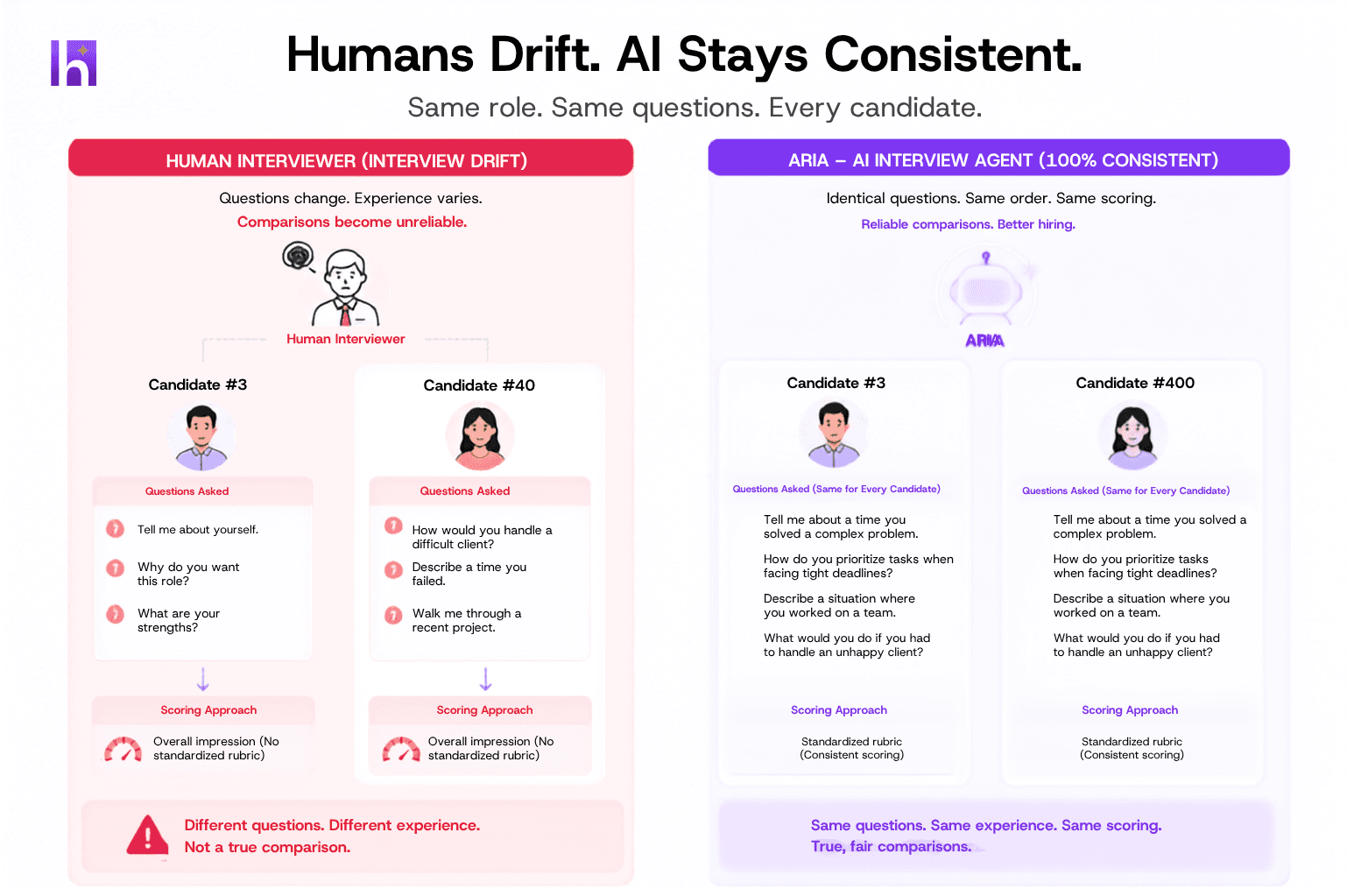
Because every candidate faces the same instrument, the output is directly comparable: ranked, scored, evidence-backed shortlists instead of gut-feel notes. And because scoring criteria are fixed in advance and applied uniformly, structure does double duty as a bias control and ensures bias-free hiring.
TL;DR: Structure fails in practice because humans drift from it. AI holds the structure at any volume, which is the whole point of the format.
FAQs
What is a structured interview in simple terms?
A structured interview is one where every candidate for a role is asked the same questions, in the same order, and scored on the same predefined rubric, so answers can be compared fairly.
What is the difference between a structured and unstructured interview?
A structured interview uses fixed questions, a fixed order, and a scoring rubric for all candidates. An unstructured interview is an improvised conversation with no standard questions or scoring, which makes candidates hard to compare and invites bias.
Are structured interviews better at predicting job performance?
Yes. Schmidt and Hunter's 1998 meta-analysis found structured interviews have a predictive validity of .51 versus .38 for unstructured interviews, and Sackett et al.'s 2023 meta-analysis ranked them the highest-validity selection method in common use.
What types of questions are used in structured interviews?
Structured interviews typically combine behavioral questions about past experience, situational questions about hypothetical scenarios, and job-specific questions about skills and knowledge, each scored against a predefined rubric.
Can AI conduct structured interviews?
Yes. AI interview agents like Hello Recruiter's ARIA ask every candidate the same questions in the same order and score answers against the same rubric, which removes the interviewer drift that breaks structured interviews in practice.
Blog Summary (Key Takeaways)
A structured interview standardizes questions, order, and scoring for every candidate in a role.
Research puts structured interviews at .51 predictive validity versus .38 for unstructured (Schmidt & Hunter, 1998); Sackett et al. (2023) rank them the strongest common selection method.
Most “structured” interviews fail through drift: skipped questions, reworded prompts, and memory-based scoring.
Effective question sets mix behavioral, situational, and job-specific questions, each with pre-written scoring anchors.
AI interview agents remove drift entirely: ARIA runs identical structured screens for HR and general roles, MAX for technical assessments.
Consistency is also a fairness mechanism: fixed criteria applied uniformly reduce room for bias.
Structured Interviews, Interview Process, Hiring Best Practices, AI Interviewing, Candidate Evaluation

Marketing Manager, Hello Recruiter
Neha is the Marketing Manager at hellorecruiter.ai, an AI hiring platform built for businesses and staffing agencies. With a background in marketing and content strategy in recruitment niche, Neha focuses on helping hiring teams understand where AI genuinely fits into recruiting. Her work spans the full arc of hiring, from how roles get defined to how the right people get chosen, and everything that happens in between.