
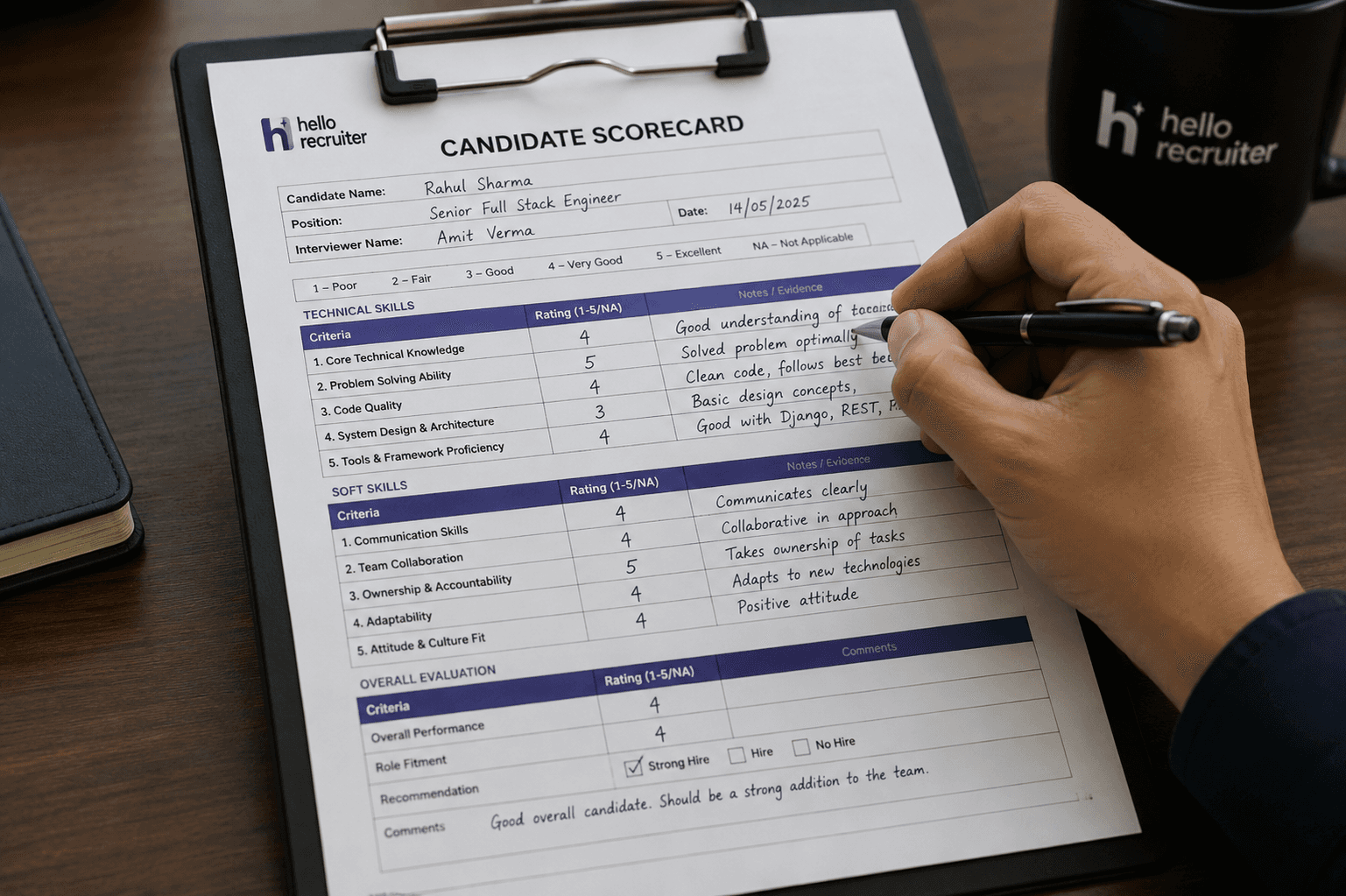
An interview scorecard is a form that rates a candidate against specific criteria decided before the interview starts, with evidence for each rating instead of a general impression written up after the interview. Three things separate a real scorecard from a notes document with a number written on top:
Criteria specific to the role, not generic traits like "communication" and "culture fit" copied onto every scorecard regardless of what the job actually needs
A clear description of what a 2 looks like versus what a 4 looks like versus what a 5 looks like, so a rating means the same thing across different interviewers
An evidence line for every rating, tied to something the candidate actually said or did in that conversation
Here's what that looks like in practice:
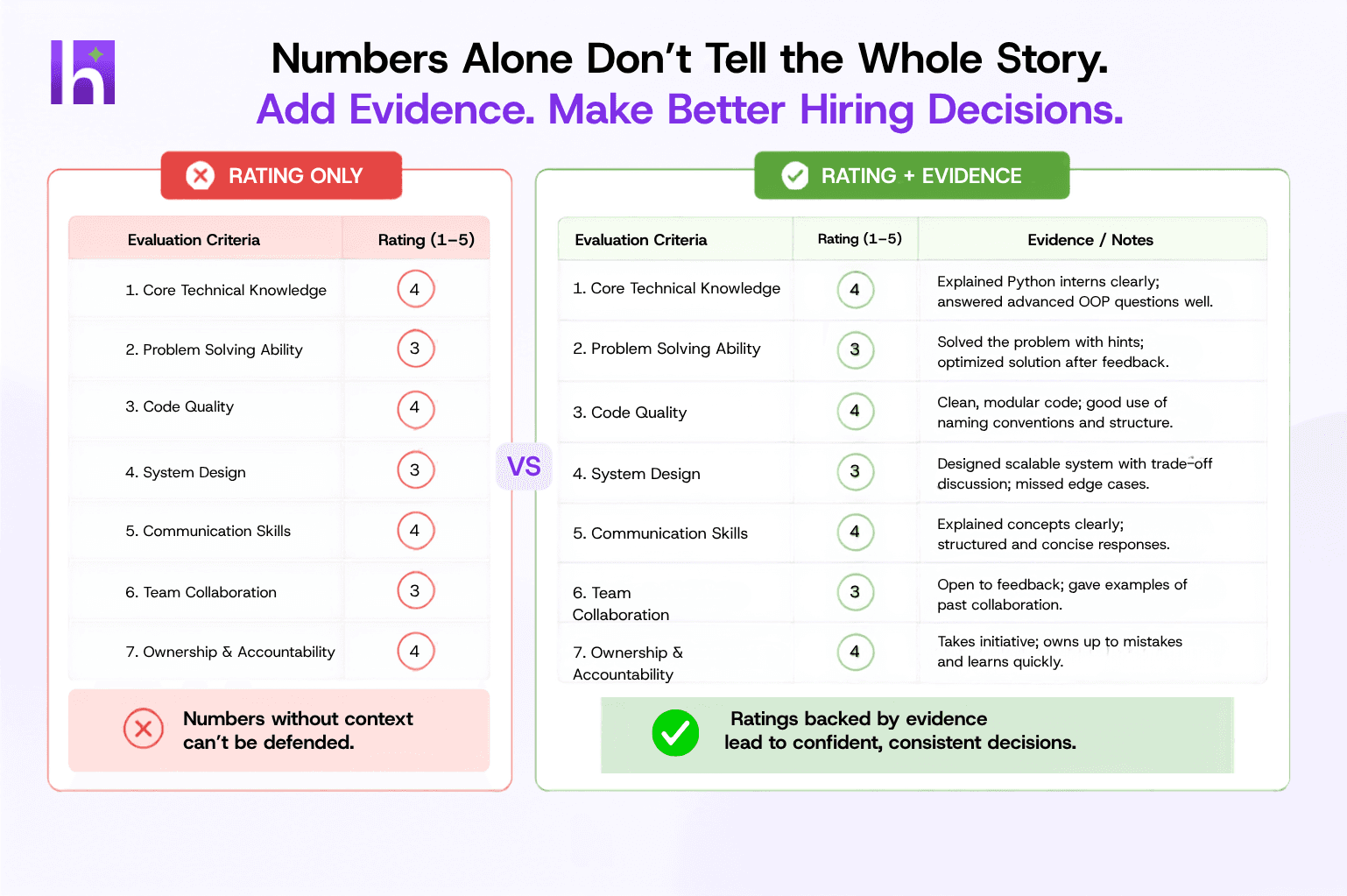
Without that evidence column, a 4 and a 3 and a 5 mean nothing six weeks later when someone's trying to remember why a candidate got the score they did.
Where Interview Scorecards Actually Break
Most interview scorecards get filled out the wrong way, and it's not the template's fault. A team interviews a candidate, talks about them afterward and only then does anyone submit a rating. By the time the scorecard gets filled in, it's not recording what the interviewer actually noticed. It's recording what the group already agreed on in the hallway.
Greenhouse, one of the largest applicant tracking systems on the market, builds an entire permission setting around this exact problem. Interviewers can be blocked from seeing each other's scorecards until everyone has submitted their own, specifically so nobody's rating gets pulled toward the group's. If the market's biggest ATS needs a setting to prevent this, it's not a rare slip-up. It's what happens by default.
And a lot of scorecards never get filled out at all. Incomplete scorecards run close to a whooping 45% across enterprise hiring panels, according to LinkedIn's own talent research, which means almost half of every debrief starts from partial information before anyone's even opened their mouth.
Scorecard bias isn't a vague, general problem. It shows up as a few specific, well-documented patterns:
Recency bias: The last candidate interviewed gets remembered more clearly than the one from Tuesday morning, regardless of who actually answered better.
Halo effect: One strong answer early in the interview sets the tone on how every answer after it gets read.
Similar-to-me bias: An interviewer rates a candidate higher because they share a background, a school, or an interest, not because the answer itself was stronger.
Contrast effect: A mediocre candidate looks better right after a genuinely weak one, and worse right after a genuinely strong one.
None of this happens because interviewers are careless. Rating people consistently is genuinely hard to do, especially the fifth or sixth time in a week.
A scorecard is supposed to be the check against exactly this, and it's the same mechanism behind structured, bias-free evaluation generally. It only works if it gets filled out independently, close to the interview, before the group talks it through, which is the same contamination problem above wearing a different name.


What Changes When AI Builds the Interview Scorecard?
There's a reason recruiters distrust AI scoring, and it's not that the AI is dumb. It's that most tools hand over a number and ask you to believe it. Ask why a candidate scored 62, and you get a shrug rendered as a progress bar. The industry has a name for this, the black-box problem, and our position on it is simple. A score you can't trace is a score you shouldn't use.
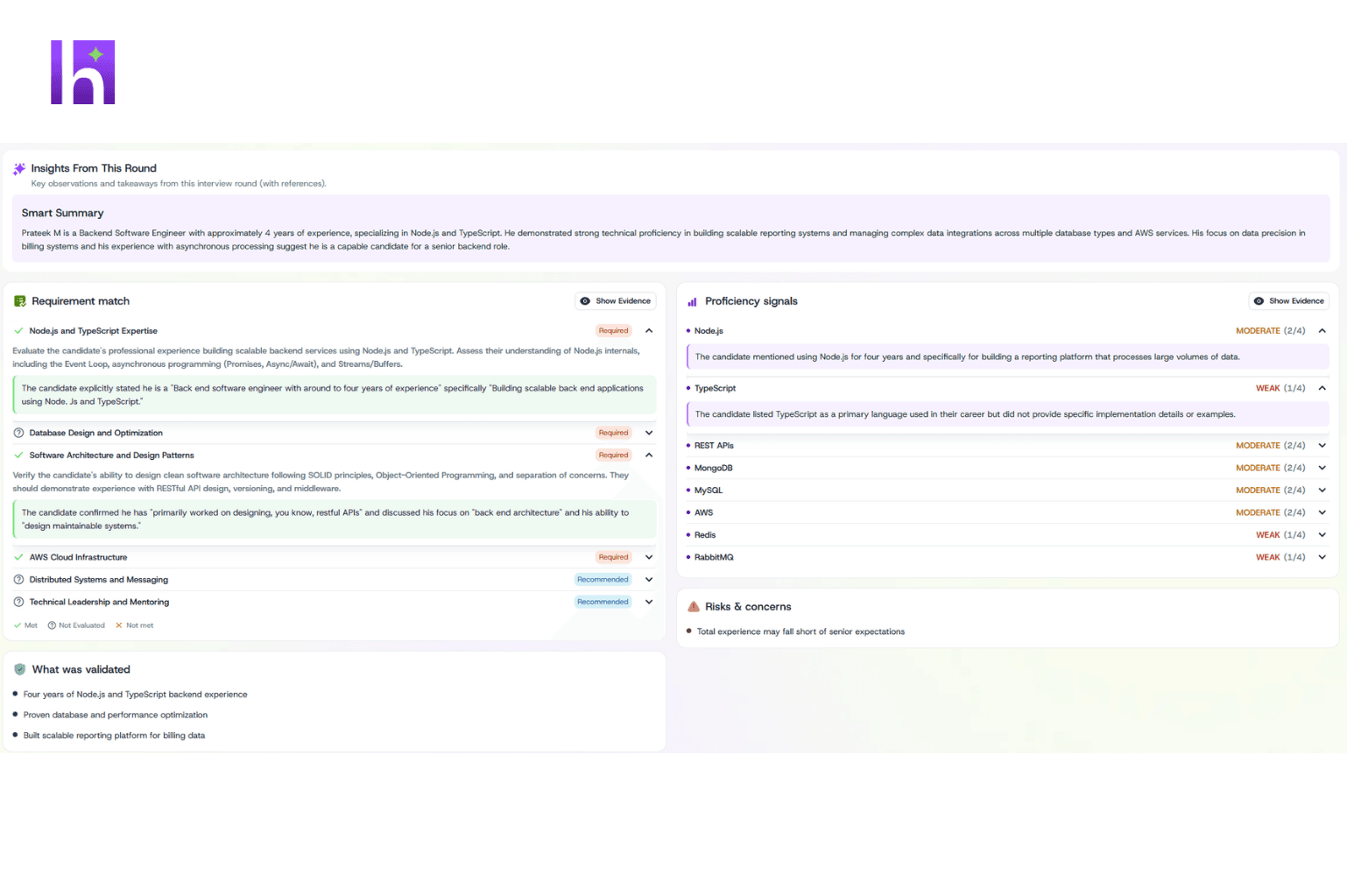
So when Hello Recruiter's AI builds a scorecard after an interview, it isn't producing an opinion. It's showing its work.
Here's what that means in practice:
Every rating carries the candidate's own words. For a criterion to be marked met, the AI has to quote the specific thing the candidate said that earned it, not a paraphrase, not a vibe, the sentence itself. The write-up next to each rating follows a hard rule too: it has to be a clean, recruiter-readable statement, and the verdict has to be the direct conclusion of that written reasoning. If the justification and the rating ever disagree, that's a bug in the system, not a puzzle for the hiring manager to untangle.
Failing a candidate takes twice the evidence that passing them does. To mark a criterion not met, the AI has to quote two things, the moment the interviewer actually probed the topic and the candidate's inadequate answer. No probe on record means no failing verdict. The criterion gets logged as not yet assessed instead. When it isn't confident enough, it gives no verdict at all. Silence is never failure. Think about what a human debrief does with a topic that never came up: twenty minutes after the interview, "we didn't get to that question" quietly becomes "The candidate seemed weak on it." This pipeline with AI makes that kind of drift structurally impossible, because a negative rating without a quoted question has nowhere to live.
Each round gets evaluated in quarantine. When the AI scores an interview, it's barred from seeing the resume, prior-round scores, or anyone's earlier impressions. It judges the spoken conversation, full stop. That closes off the contamination problem covered above completely. There's no group debrief before the scorecard exists, and no earlier round's impression to carry over, because the evaluator never sees last round in the first place. Rounds still reconcile, but in code, not in vibes. If a resume earned credit for a skill and a later interview contradicts it, the newer verdict overrides the older one because of our feature of progressive intelligence. The earlier credit stops counting immediately. It deliberately stops there, no extra penalty stacked on top, because losing points you didn't earn is accountability, and losing more than that is an algorithm holding a grudge.
None of these ratings factor in protected attributes either. The system scores what was said- not how it sounded, no competency rating comes from tone of voice, facial expression, or how confident someone seemed. The evidence that those signals predict job performance is weak. The evidence that they encode bias is not. A vendor still scoring "enthusiasm" off someone's face in 2026 is telling you what their scorecard actually measures.
The score is math, not mood. Run the same interview through twice- most AI scoring tools will quietly give you different numbers, because the model is generating a score directly. Same answers, a 71 on Monday and a 64 on Tuesday, and no one can say why.
Hello Recruiter’s AI doesn’t do mood scoring. Our AI never produces a vague number. It answers one narrow question per criterion- met, not met, or not enough evidence and must back every answer with a verbatim quote. A fixed formula then computes the score from those verdicts: same verdicts in, same number out. Borderline cases get marked not assessed instead of guessed. And a rating with no checkable quote isn't scored lower, it's never created at all.
It's still not a replacement for the hiring manager's judgment. The AI builds the evidence, the hiring manager makes the call, the same principle behind how progressive intelligence is meant to work across the platform generally. What changes is that the record they're working from holds up when someone actually pushes on it.
Here's a question worth putting to any AI interview platform, this one included: show the exact sentence the candidate said that earned each rating. For most tools, that's an awkward request. For Hello Recruiter- it's just the data model.
Where Interview Scorecard Fits With Structured Interviewing
A scorecard is only as good as the interview that feeds it. We go into the broader case for structured interviewing over freeform conversation in our piece on structured interviews. The scorecard is what makes that structure something you can actually compare across candidates, instead of a format everyone quietly stops filling out properly by the third or fourth round.
Key Takeaways
A real interview scorecard has role-specific criteria, a clear description of what each rating level actually looks like, and an evidence line for every rating, not just a number
Most scorecards fail from contamination, not bad templates, filled out after a debrief instead of before one
Close to half of scorecards across enterprise panels never get submitted complete at all
Recency, halo effect, similar-to-me bias, and contrast effect are the actual mechanisms behind Interview scoring "bias," not an abstract concept
The fix is procedural- Interview scorecard filled out independently, close to the interview before anyone talks it through as a group
Hello Recruiter's AI requires a verbatim quote for every rating, and needs two quotes, not one, to fail a candidate, so silence never gets scored as a negative
Frequently Asked Questions
What is an interview scorecard?
A form that rates a candidate against specific criteria set before the interview, with evidence for each rating, instead of a general impression written up afterward.
What's the difference between a scorecard and just taking notes?
Notes capture impressions in whatever form the interviewer feels like using. A scorecard forces the same structure and the same criteria across every interviewer and every candidate, which is what makes candidates actually comparable.
Does using a scorecard actually reduce bias?
It reduces specific, well-documented biases like recency and halo effect, but only if it's filled out independently and close to the interview. A scorecard filled out after a lapse of time or group discussion has already lost that protection.
When should a scorecard be filled out?
As close to the interview as possible. Waiting until after a group discussion or lapse of time is the single most common way scorecards stop doing their job.
Does AI-generated scoring introduce bias? Hello Recruiter's scoring doesn't factor in protected attributes (example- demographic, linguistic, or stylistic biases) and it applies the same criteria to every candidate regardless of interview order, which is exactly where human consistency tends to break down first.
Want to see what an AI-generated scorecard actually looks like? [Get in touch with Hello Recruiter.]
interview scorecard, structured interviews, hiring bias, candidate evaluation, recruiting best practices

Founding Engineer, Hello Recruiter
Prateek is one of the founding engineers at hellorecruiter.ai, an AI hiring platform built for businesses and staffing agencies. With a background in software engineering, Prateek focuses on building the systems that let hiring teams move faster without losing the judgment that good hiring still depends on. His work spans the technical backbone of the platform, from how AI agents evaluate and screen candidates to how the product connects with the tools recruiting teams already rely on.