
The recruiting fee hasn't moved in 20 years. Everything else has

I have sat on a lot of sides of the hiring table- Internal recruiting teams, retained search firms, contingency recruiting, outsourced agencies, offshore sourcing teams, executive search firms and partners.
Lot of things in recruitment has kept evolving and has changed with time but one strange thing has remained constant: recruiting agency fees.
Recruiting fees range hasn't shifted for almost two decades now- Most agencies still charge about 15-25% of a candidate's yearly salary meanwhile for the executive position hiring this moves up to 25-35% of the total compensation given to a candidate.
Talking about the things that have actually shifted/evolved in the last two decades are how most of the repetitive work that recruiters did is now automated.
Candidate application or sourcing? Resume screening? Interview: Scheduling and conducting? All automated. Most of these tasks can be done now by a software rather than a human being still working with spreadsheets.
The topic of concern here is despite a lot of the repetitive work now being automated and now that recruiters are not spending as much time and effort on task’s they did before, why is the fee structure for recruitment still the same?
Recruiters charging for their expertise is absolutely correct and justified but looking at how other things in this job has changed but pricing hasn’t is the problem.
To be clear, this isn't about bashing recruiters or agencies. Great recruiters earn every single penny they charge. When a job needs a deep personal network, sharp human judgment, or real hard work, paying for an expert is completely worth it.
What this article is really about is pulling back the curtain: explaining how agency fees work, what actually drives prices up or down, and why the way we talk about pricing hasn't caught up with modern hiring. If you're the one paying the bill, you'll know exactly what your money is buying. And if you're the one charging the fee, you'll see where client expectations are moving and how to prove your real value.
Where does the confusion start?
Before we dive into the fees and math, here are three common misunderstandings that keep people confused about recruiter pricing:
Placement fees and staffing markups- both are completely different: A placement fee is a one-time percentage of a new employee's annual salary which is paid when a permanent hire is made. A staffing markup applies to temporary or contract workers, where the agency adds an extra 35% to 50% on top of the worker's hourly pay. People mix these two up all the time, but the math for both works totally differently.
Job seekers never pay this fee: The hiring company pays for everything. In the US, the UK, and most of Europe, agencies cannot legally or ethically charge candidates for finding them a job. If you are applying for a role, this money does not come out of your salary offer.
Different price quotes for the same job are normal: You might have observed that sometimes two different recruiters quote different prices for the exact same position, it usually isn't a scam. It just means the company hired multiple agencies to compete for the role, or the recruiters are using different fee structures, as simple as that.
Contingency VS Retained recruitment search fee models and others:
There are five models that are most commonly used nowadays by agencies to structure their fees.
A recruiter saying 'I charge 20%' doesn't tell you much. There are five ways they structure their fees, so that number only makes sense when you know what kind of deal you're actually signing.
Below are the five different models: x
Model | Fee range | When its paid | Best fit |
|---|---|---|---|
Contingency | 15-25% of first year salary | Only on successful hire | Mid-level roles |
Retained search | 25-30% of total comp | In installment’s | Executive or confidential roles |
Flat fee | $5000- $20000 per hire | On Placement fixed | High-salary roles with moderate search difficulty |
Staffing agency markup (Temp/contract) | 35-50% on hourly wage | Ongoing per hour billed | Temp and contract staffing |
Temp-to-perm conversion | Prorated percentage of salary | When converting a temp to permanent | Companies extending a temp to a full-time role |
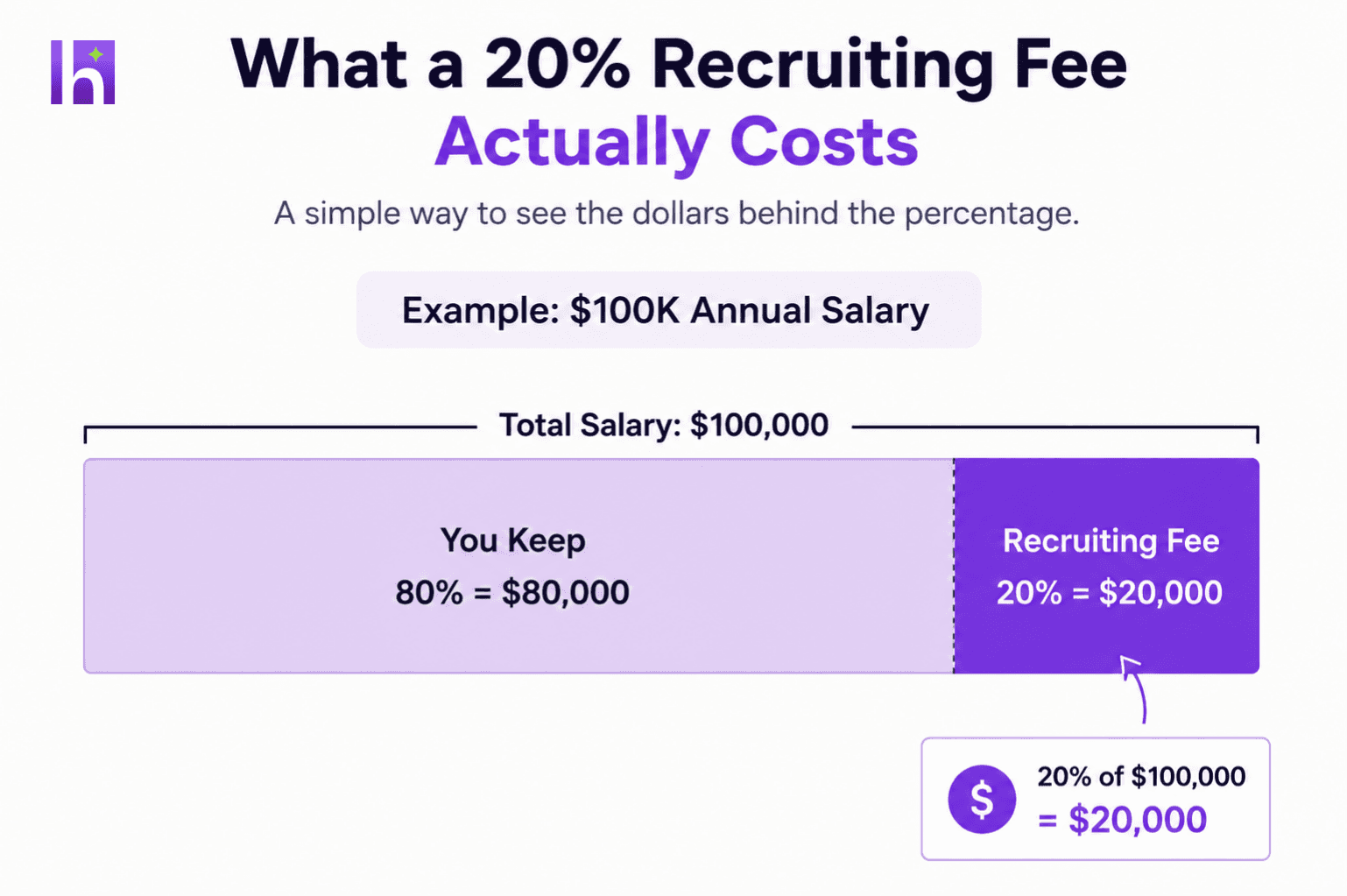
Here’s a quick example to make the math easy to understand: If you hire someone at a $100,000 salary with a 20% fee, you owe the recruiter $20,000. Simple enough. The thing that isn't as clear is what that $20,000 actually gets you, and if it's still worth it today.
The hidden cost nobody adds up is:
Those fees add up fast. If a company hires ten software engineers a year at $130,000 each with a 20% fee, they’re paying over $260,000 just in recruiter fees. Or take healthcare: hiring 25 nurses at $85,000 each means over $425,000 out the door.
And that $20,000 checks-written number is just the start. It leaves out all the extra money and time you spend along the way:
Paying to post the job online
Hours spent digging through stacks of resumes
The hassle of scheduling multiple interviews
Your team’s wasted time sitting in those interviews
Candidates dropping out at the last minute
The massive cost if the new hire leaves right after their guarantee period ends
The agency's fee is just the price tag on paper. The true cost of hire is way higher for everyone involved.
If you're the one paying the recruitment fee
Most of the people out there giving advice would tell you to promise 10+ hires or maybe exclusive rights to the job so that the recruiter or agency would reduce 3-5% of their fees. This might work if you have a big company, but if you have a small business where you are hiring only one or two odd people then this advice would not work for you.
For small businesses here are some pointers which can help you bargain:
Shorten their exclusive rights window instead of cutting their price: Recruiters care a lot about how long they get to lock you down. Agreeing to let them be your only recruiter for just 30 to 60 days instead of 6 to 12 months is much easier for them to accept than a fee cut.
Ask for a longer guarantee instead of a lower rate: If a new hire doesn't work out, you want your money back (or a free replacement). Pushing for a 120-day guarantee instead of the standard 90 days lowers your risk without asking the recruiter to take less pay.
Get a clear, written list of who they own: Small businesses often use two or three agencies at once to find candidates faster. Make each agency send you the specific names of people they submitted. If you don't get this in writing, two different agencies could claim they found the same candidate, and you could end up stuck with two separate bills for one hire.
A quick checklist before you sign anything:
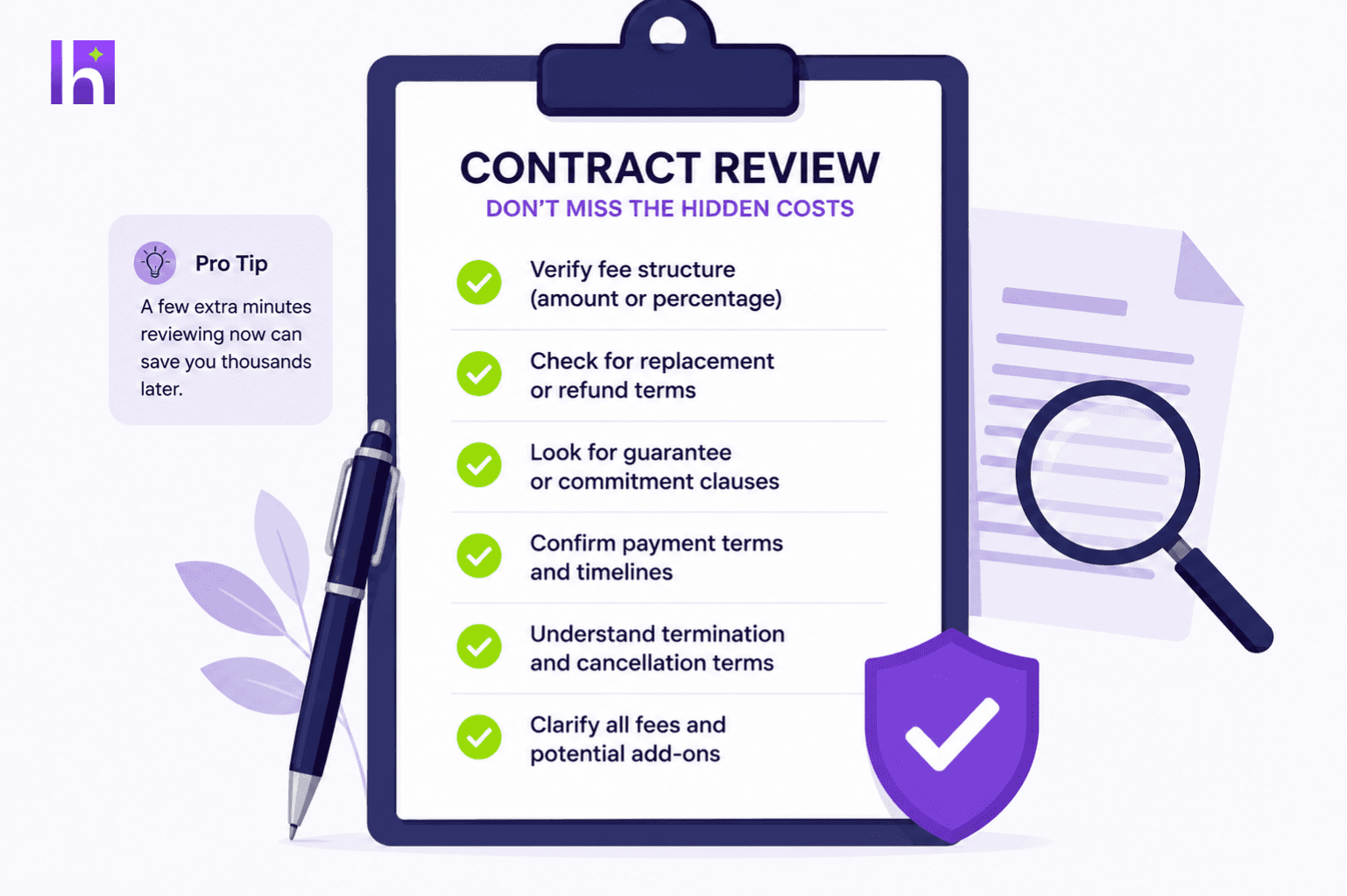
Exclusivity window is 90 days or less, or explicitly non-exclusive
Guarantee period covers at least 90 days, with clear replacement or refund terms
Candidate ownership is a named list, not a blanket claim
Payment terms are net-30 or better, not open-ended
The fee percentage is justified against the role's actual seniority and scarcity, not just quoted as "standard"
If you're the one charging the recruitment fee
This isn't just a headache for clients. If you run a recruiting agency, you're dealing with clients who've already read half a dozen articles like this one. They know the "standard" rates and expect you to justify your price before you even finish your pitch.
Where the trust and profit problems actually come from:
Here are a few realities worth keeping in mind
Clients don't fully trust how you get paid: Many hiring managers secretly think recruiters push for higher salaries just to boost their own commission. Even if you'd never do that, the suspicion is there. Bringing it up yourself and showing how much work and risk you're taking on works way better than pretending the issue doesn't exist.
Clients care about your results, not just your rates: A 20% fee feels totally worth it if you bring in great people fast. It feels like a rip-off if you don't. How fast you send a great shortlist and how well you judge cultural fit matter way more than competing purely on price.
You lose money on wasted hours, not lower fees: Sourcing candidates, reading resumes, and playing phone tag to schedule interviews eat up most of your time. Clients don't actually care about that hectic work- they're paying for your network and judgment. Assigning those time consuming tasks to automated tools lets you handle more searches, keep your profit margins high, and offer better prices without hurting your bottom line.


The recruitment workflow hasn't caught up to the tools
Traditional recruiting agencies earned their money by doing the heavy lifting to find candidates. Back then, it took real manual work: digging through databases, making cold calls, updating spreadsheets, and reading every single resume by hand. Twenty years ago, all that hard work was where the actual value came from.
Today, AI can handle a huge chunk of that work- like sorting resumes, screening applicants, scheduling interviews, and doing basic skill checks in a small chunk of the time it takes a human.
The problem is that most hiring processes haven't caught up. Companies still post a job, wait for resumes, manually read through hundreds of applications, and run round after round of interviews. The technology evolved yet the routine stayed the same. Getting more applications doesn't solve anything either- it just creates a bigger pile of noise for recruiters to dig through without giving you better candidates.
From cost per placement to cost per insight
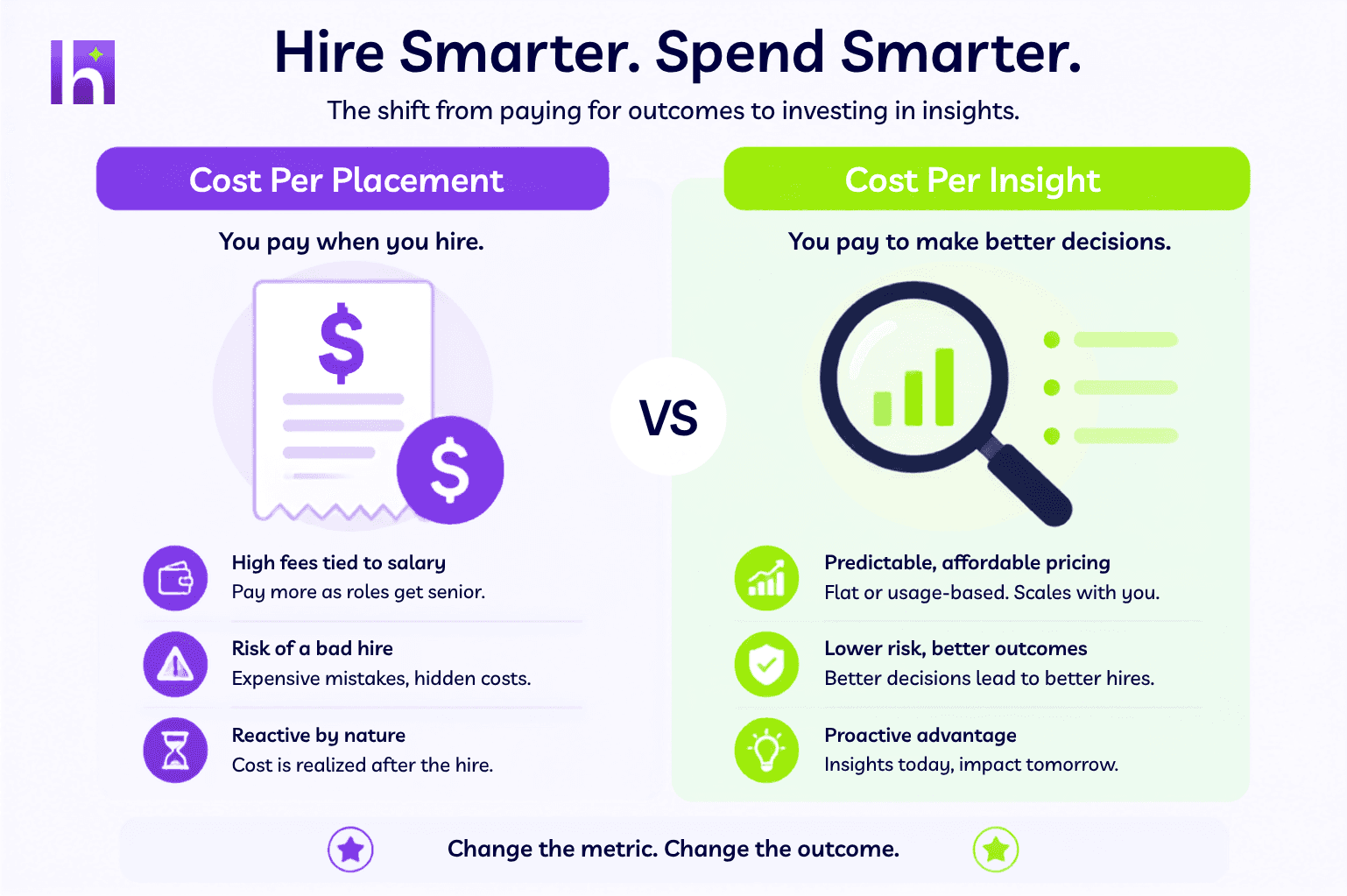
For decades, recruiting focused on just one outcome: filling the seat. Moving forward, the real question is different: how fast can you actually figure out if a candidate can do the work?
A resume alone can't give you that answer anymore- especially now that almost everyone uses AI to polish their resumes and prep for interviews. You need real context: can this person explain their decisions, communicate clearly, and back up what they put on paper? That kind of insight is way more valuable than just dumping ten more resumes into your inbox.
That’s why we built Hello Recruiter. It isn't meant to replace recruiters. Instead, it handles the repetitive work like the initial screening, structured interviews, and basic assessments so recruiters can focus on what actually matters: using their human judgment to evaluate candidate fit. These automated tools exist to give you deeper insights faster, not to make the final hiring decision for you and at the same time this also ensures there is no gap in providing a great candidate experience as Hello Recruiter’s AI takes care of this too by keeping the candidate up to date about what hiring stage are they at currently.
The recruiters who win in the long run won't be the ones fighting against the shift but the ones using it to spend less time managing paperwork and more time helping companies make the right hire.
When the fee is still worth it, and when the model's due for a rethink
An agency fee is still totally worth it when a job is genuinely hard to fill- like a secret executive hire, a role in a location where nobody knows your company, or a rare technical skill set your team can't find on its own. Paying for a recruiter's network and expertise in those situations makes total sense.
Where you should question the fee is everywhere else: everyday middle-management roles and high-volume hiring. In those cases, the hardest part isn't finding people- it's sorting through candidates fast enough to make a good, confident decision. That’s the exact part of hiring that has changed the most in recent years, and it's why twenty-year-old pricing models don't make much sense for those roles anymore.
Key Takeaways
Recruiter fees haven't changed in 20 years, but the work has: Agencies still charge 15% to 35%, even though modern tech has made finding and screening candidates much faster.
A price quote means nothing without the context: Agencies use five different fee setups, and each one uses different math. Comparing raw percentages without knowing the deal structure is why people get confused.
The recruiter's bill is only a fraction of the real cost: The hidden expense comes from wasted time: reading resumes, scheduling interviews, candidates dropping out, and having to restart searches from scratch.
Small businesses should negotiate terms, not fees: If you don't hire enough people to ask for a big discount, focus on getting shorter exclusivity periods or longer replacement guarantees instead.
Manual labour burns through agency profits: Clients care about speed and candidate quality, not how many hours a recruiter spent hunting. Spending hours on manual tasks eats away at an agency's bottom line.
You're no longer paying for legwork- you're paying for good judgment: The recruiting industry is moving away from charging for basic tasks and moving toward charging for fast, reliable hiring insights.
Frequently Asked Questions
Does the recruiter's fee come out of my salary as a job seeker?
No. The hiring company pays the entire fee. In the US, UK, and most of Europe, agencies can't legally or ethically charge you money for finding you a job.
Why did two recruiters quote different prices for the exact same job?
That's normal. It usually means the company hired multiple agencies to race for the same spot, or the recruiters are using different fee setups (like one charging upfront and another charging only after a hire).
What's the difference between a placement fee and a staffing markup?
A placement fee is a one-time percentage of a full-time employee's annual salary. A staffing markup is an extra 35% to 50% added on top of a temp or contract worker's hourly pay. They use totally different math.
Is 20% a standard recruiter fee?
Yes. Standard fees usually fall between 15% and 25% of the new hire's first-year salary. For high-level executive searches, that number can go up to 35%.
Do I still have to pay if the new hire quits right away?
It depends on your contract's guarantee window, which is usually 60 to 90 days. If they leave during that time, the agency will usually find you a replacement for free or refund part of your money. After that window passes, you're on the hook.
Can you actually negotiate recruiter fees?
Yes, almost always. If you can't promise a lot of future hiring business to get a discount, you can still negotiate for a longer candidate guarantee, a shorter exclusive period, or clearer rules on who owns which candidate.
Recruiting shouldn't cost this much to still feel this manual.
See how Hello Recruiter screens and interviews candidates automatically
recruiting fees, staffing agencies, hiring costs, AI recruiting, SMB hiring

Co-Founder, Global GTM and CFO
Avi Tiwari is a seasoned finance and strategy professional with over two decades of experience across continents and industries. As a business consultant, Avi specializes in driving growth through financial planning, strategic insights, and innovative solutions. His expertise spans startups, private equity ventures, and international expansions, leveraging certifications in M&A, AI tools, and an MBA in Finance & Marketing to deliver impactful results.